

Debt Acknowledgment in Thailand: What It Is, How It Differs From a Loan Agreement, and How the Limitation Period Resets
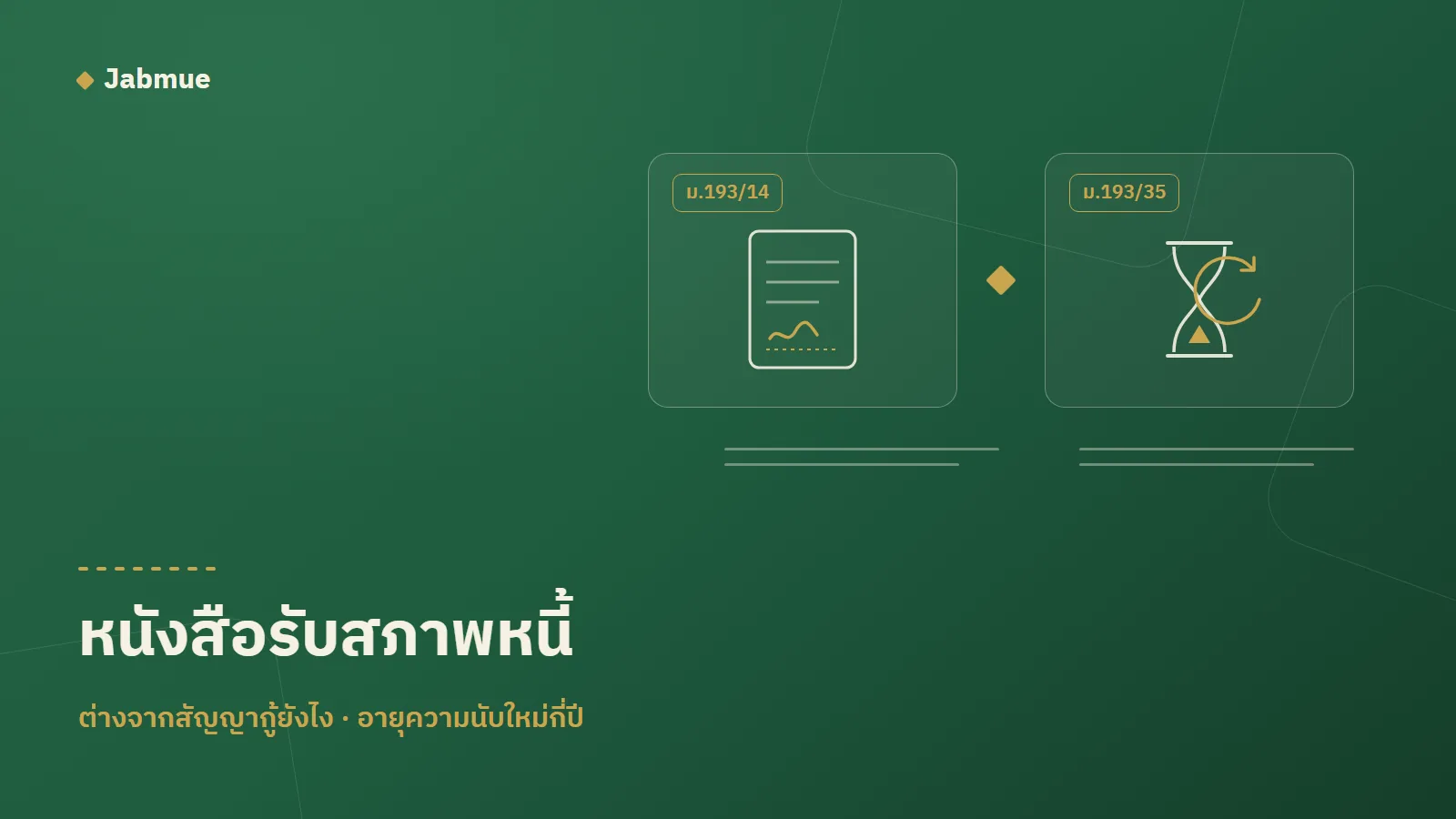
A debt without a contract is not always a lost cause. If the debtor is willing to sign a debt acknowledgment letter (หนังสือรับสภาพหนี้), the creditor gains both written evidence and, potentially, a fresh window of time to take legal action.
The typical situations: you lent money to a relative on a verbal agreement, a customer never paid for goods, or an existing debt was restructured into a new instalment plan. This article explains what a debt acknowledgment is, how it differs from a loan agreement, what it does to the limitation period, and whether it can be signed online.
TL;DR: A debt acknowledgment is a document in which the debtor signs to confirm that a debt genuinely exists. It is used for debts that have already arisen (verbal loans, unpaid goods, damages) — unlike a loan agreement, which is the contract that creates the debt in the first place. Its most important effect is that it interrupts the limitation period and restarts the clock in full (Section 193/14 of the Civil and Commercial Code). But if the debt is already time-barred, an acknowledgment of liability gives only a 2-year fresh limitation period (Section 193/35). The law does not require witnesses; what matters is the debtor's signature, which can be applied electronically under the Electronic Transactions Act B.E. 2544 (2001). (General information, not legal advice.)
Key Takeaways
- A debt acknowledgment is a unilateral document in which the debtor confirms an existing debt; it does not create a new one
- The limitation period is interrupted and restarts in full if the acknowledgment is made before the debt becomes time-barred (Sections 193/14, 193/15)
- If the debt is already time-barred, the acknowledgment gives only a fresh 2-year period (Section 193/35)
- Witnesses are not legally required; the debtor's signature is what matters
- A LINE chat in which the debtor admits the debt may interrupt the limitation period, but as evidence it "may not be clear enough" compared with a signed document
- It can be signed online under the Electronic Transactions Act B.E. 2544 (2001)
What Is a Debt Acknowledgment?
A debt acknowledgment is a unilateral document in which the debtor signs to confirm a debt that has already arisen — whether from a loan, unpaid goods, or damages. It is not a contract that creates a new debt.
The difference from a loan agreement: a loan agreement is the originating contract that brings the debt into existence, while a debt acknowledgment is a later confirmation that an existing debt is real.
| Loan agreement | Debt acknowledgment | |
|---|---|---|
| Nature | Two-party contract, creates the debt from the start | Unilateral document, confirms an existing debt |
| When used | Before lending the money | After the debt exists, e.g. verbal loan, unpaid invoices |
| Who signs | Lender and borrower | Primarily the debtor |
If there is no originating contract yet, read the full guide to loan agreements in Thailand alongside this one.
What Happens to the Limitation Period?
Acknowledging a debt interrupts the limitation period: the time that has already run is wiped out and the full period starts counting again (Sections 193/14, 193/15). But if the debt was already time-barred before the acknowledgment, the law grants only a fresh 2-year period (Section 193/35).
This is the single most important distinction in this article, because the outcome differs enormously depending on whether the debt was still within time — or already time-barred — on the day the debtor signed.
What a Debt Acknowledgment Must Say
A debt acknowledgment that actually works must identify the parties, state the origin of the debt, the amount acknowledged, the repayment terms, the date of the document, and carry the debtor's signature.
- Party identification — names and addresses of creditor and debtor
- Origin of the debt — e.g. a verbal loan, unpaid goods, or damages
- Amount acknowledged — including interest if any, which must not exceed 15% per year under the same principle that governs loan agreements
- Repayment terms — the agreed date or instalment plan
- Date of the document and the debtor's signature — the indispensable core
Do You Need Witnesses? Does It Need to Be Registered?
No witnesses are required, and there is no registration with any government office. The law does not require a debt acknowledgment to be witnessed — though adding witnesses is an option that can strengthen the evidentiary weight.
Does a LINE Chat Where the Debtor Admits the Debt Count?
A chat message in which the debtor clearly admits the debt — "I'll pay next month" — may be enough to interrupt the limitation period. But as evidence it "may not be clear enough" compared with a signed document, because proving who typed the messages and their context is harder. A clearly signed document is always the more solid option.
The Debt Is Already Time-Barred — Can You Still Do This?
Yes. A time-barred debt does not disappear; the debtor merely gains the right to refuse payment. If the debtor acknowledges liability after the debt has become time-barred, the law grants a fresh 2-year limitation period — and if the debtor voluntarily pays, the payment cannot be reclaimed.
Can a Debt Acknowledgment Be Signed Online?
Yes. The core of a debt acknowledgment is the debtor's signature, and electronic signatures are recognized under the Electronic Transactions Act B.E. 2544 (2001) — provided the method used is reliable and can be verified after the fact.
The practical advantage: debtors are often far away or avoid meeting in person. Sending an online signing link removes the scheduling and printing obstacles. OTP identity verification and a recorded audit trail strengthen the evidentiary weight regarding who signed — they are not an absolute, 100% legal guarantee.
Read the full guide to the legal validity of electronic signatures in Thailand
How to Create a Debt Acknowledgment in 10 Minutes
Create the debt acknowledgment in the Jabmue document editor: fill in the parties, the origin of the debt, the amount, and the repayment terms, then send the debtor a signing link. You get a PDF with a complete record of when it was signed.
Jabmue provides document templates and signing tools; it is not a legal advisor. For complex debts or existing disputes, consult a lawyer before proceeding.
Frequently Asked Questions
What is a debt acknowledgment letter?
A unilateral document in which the debtor signs to confirm an existing debt — whether from a loan, unpaid goods, or damages. It differs from a loan agreement, which is the contract that creates the debt in the first place.
Are witnesses required?
No. The law does not require witnesses on a debt acknowledgment, though adding them can strengthen the evidentiary weight.
How many years does the limitation period reset to?
If signed before the debt becomes time-barred, the limitation period is interrupted and restarts in full. If the debt is already time-barred, the acknowledgment grants only a fresh 2-year period.
How is it different from a loan agreement?
A loan agreement is the contract that creates the debt from the start. A debt acknowledgment is a unilateral document confirming a debt that already exists — typically used when there was no originating contract, or to re-confirm the debt.
Can it be signed online?
Yes, under the Electronic Transactions Act B.E. 2544 (2001), provided the signing method is reliable and verifiable after the fact.
Summary
A debt acknowledgment is the creditor's tool for creating written evidence after the fact — and potentially restarting the limitation period. The critical distinction: the outcome depends entirely on whether the debt is still within time or already time-barred.
If you don't yet have an originating contract for a new loan, read the loan agreement guide alongside this one.
Try it free — create a debt acknowledgment and send it for signature
This content is general information, not legal advice for any specific case. Consult a legal advisor before using any document.
What Is Stamp Duty in Thailand? Which Contracts Need It, and What to Do When You Sign Online (2026)
What is stamp duty, which contracts in Thailand need it, and do contracts signed online through a system like Jabmue still owe stamp duty? Plus how to pay electronic stamp duty (e-Stamp) through the Thai Revenue Department.
Read article →Can You Sign Documents via LINE? A Straight Answer (2026)
Can you sign documents via LINE? Yes, but sending a photo of a signature in chat and signing through an OTP-verified link carry very different legal weight. Here's the comparison.
Read article →Is Daily Condo Rental (Airbnb-Style) Legal in Thailand? What to Know Before Signing a Short-Term Rental Contract
Renting out a condo by the day, Airbnb-style, sits in a genuine legal grey zone in Thailand. The Hotel Act B.E. 2547 (2004) and condominium juristic person rules can both apply. This article explains the risks honestly, plus the clauses a short-term rental contract should include.
Read article →Service Agreement in Thailand: Hire of Work vs Employment Contract, What Actually Changes
A Thai service agreement (hire of work) and an employment contract look similar, but the tax and legal consequences are very different. See the 6 clauses every B2B service agreement needs, plus the points Thai businesses miss most often.
Read article →Rental Security Deposit in Thailand: When It Must Be Returned, What Can Be Deducted, and the Refund Letter
When must a rental security deposit be returned in Thailand? What deductions are lawful, what tenants can do if it isn't returned, and the deposit refund letter every landlord should use — with a ready-made template.
Read article →Thai Receipt Template: How It Differs from e-Tax Invoice, and What Jabmue Can (and Can't) Do
An ordinary receipt and the Revenue Department's e-Tax Invoice are not the same document. This article explains the difference, and says it plainly: Jabmue can create and sign electronic receipts, but it is not an e-Tax Invoice system that files directly with the Revenue Department.
Read article →Quotation Template Thailand: What to Include, Is It Binding, and Can Clients Accept Online?
Quotation template for Thailand: the elements every quote needs, itemized pricing, 7% VAT, validity period, how a quote differs from a purchase order, and how to get clients to sign their acceptance online.
Read article →Property Purchase Agreement + Deposit in Thailand: What to Check Before You Sign
Thailand's agreement to purchase and sell explained: the deposit terms, the clauses it must contain, what happens on breach, and how it differs from the ownership transfer at the Land Department.
Read article →Loan Agreement in Thailand: Over ฿2,000 Needs Written Evidence, Interest Capped at 15%/Year
What must a Thai loan agreement include? Loans over ฿2,000 need signed written evidence (Section 653), interest is capped at 15% per year (Section 654), plus stamp duty and how to sign online.
Read article →Thailand's Draft ETA Amendment (2026): What Could Change
ETDA is seeking public comment on a draft ETA amendment. This is still a draft, not law in force yet: here's what it proposes and the latest status.
Read article →PDPA for Real Estate Agents: How to Collect Tenant and Buyer Data Legally
How real estate agents can collect tenant and buyer data in line with the PDPA — a practical checklist, plus what to watch out for when asking for ID card copies
Read article →Is a Pasted Signature Image in a PDF Valid? How It Differs from a Real E-Signature (2026)
Is a pasted signature image in a PDF valid? It works in practice, but it is not an electronic signature in the legal sense. Here's the difference, and the risks you should know before using one.
Read article →Is an MOU Legally Binding in Thailand? The Honest Answer Is "It Depends", and Here's How to Check
Many people assume an MOU is never legally binding. In some cases, though, a Thai court may read an MOU as an enforceable contract. Learn the 4 things that make an MOU binding by accident, and how to draft one that matches what you actually intend.
Read article →NDA in Thailand: Template, Key Clauses and E-Signing
A sample NDA for Thai businesses: essential clauses, fair duration, penalties courts won't reduce, and how it differs from PDPA. Ready-to-sign template.
Read article →Jabmue vs zDOX: 2026 Comparison (Generic Templates or Ready-to-Use Thai Legal Contracts)
Jabmue vs zDOX compared: per-user pricing, Thai legal contract templates, LINE bot, NDID, and PromptPay (prices verified Aug 2026)
Read article →Jabmue vs eSigns.cloud: 2026 Comparison (Tax-Audit Readiness or an All-in-One Contract Tool)
Jabmue vs eSigns.cloud compared: pricing, document editor, Thai legal templates, e-Tax XML, and PromptPay (prices verified Aug 2026).
Read article →Jabmue vs DocuSign (2026): Which E-Signature Tool Fits Your Thailand Operations?
Jabmue vs DocuSign compared for companies operating in Thailand: pricing, Thai-language support, PromptPay, LINE, and legal templates. Verified August 2026.
Read article →Best E-Signature Tools in Thailand (2026): Pricing, Features, and the Right Pick for Your Business
Compare Jabmue, eSigns.cloud, zDOX, Veracity, and 5 more: real pricing, Thai legal templates, PromptPay, and LINE support — pricing verified Aug 2026
Read article →Real Estate Broker Agreement in Thailand: Protect Your Commission
Real estate broker agreement Thailand sample with explanation: Thai law doesn't require it in writing, but in practice, without written proof, claiming your commission is extremely difficult. References Sections 845-846 of the Civil and Commercial Code, plus a ready-to-use exclusive listing agreement template.
Read article →PDPA Checklist for Clinics in Thailand: 9 Obligations, 9 Documents
PDPA checklist for clinics in Thailand: how patient data consent works, whether you need a DPO, and what documents you actually need — with templates ready to sign.
Read article →Are Electronically Signed Documents Admissible in Thai Courts? FAQ (Updated 2026)
Are electronically signed documents admissible in Thai courts? The short answer is yes, with conditions, under the Electronic Transactions Act B.E. 2544 (2001) — with real Supreme Court decisions and ways to strengthen reliability using OTP and an audit trail.
Read article →Lease Termination Notice in Thailand: Templates and Legal Steps
What must a lease termination notice and overdue rent demand letter include? Read the steps under Sections 560/566 of the Civil and Commercial Code, with the correct structure and provable delivery methods (Updated 2026).
Read article →The HR Documents You'll Issue Most Often in Thailand: Warning Letters, Resignation Letters, Employment Certificates
Warning letters, resignation letters, and employment certificates are the 3 HR documents Thai SMEs issue most often, and getting them wrong creates real legal problems. Learn how long a warning letter stays valid, the real resignation notice rules, and what employers are legally required to issue.
Read article →How to Send a Document for Online Signature in 10 Minutes (With Real Screenshots)
Send a document for online signature in 10 minutes — no printing, no scanning, no account needed for the signer, with real screenshots of every step
Read article →Can AI Draft a Contract? What the Risks Are (A Straight Answer for 2026)
Can AI like ChatGPT or Gemini draft a contract? Yes, but there are risks you need to know: legal references that may be outdated, potentially unfair contract terms, and the fact that AI-written text is not a legally binding document.
Read article →Power of Attorney in Thailand: Which Form for Which Use?
Power of Attorney Thailand: which form for which use? This guide maps every POA type, Land Office to general business, and what is e-signable.
Read article →PDPA Consent Form Generator: Beyond the Cookie Banner
Most PDPA consent form generators only cover cookies. Build a printable, bilingual consent form for Thai clinics and SMEs, free templates included.
Read article →Notary Public in Thailand vs. E-Signature: What Foreigners Need
Thailand has no Western-style notary public, only Notarial Services Attorneys. Here's when you actually need one and when a legally valid e-signature is enough.
Read article →Is E-Signature Legal in Thailand? The Complete Guide to Thai Law (2026 Update)
Is an electronic signature legal in Thailand? Yes — under the Electronic Transactions Act B.E. 2544 (2001). Full guide: signature types, court evidence, exceptions, and the 2026 draft law.
Read article →Freelance Contract in Thailand: From LINE Chats to a Signed Agreement
Freelancers in Thailand have no labor-law protection. See the 8 clauses your contract needs, and how to turn LINE chats into a signed agreement.
Read article →Employment Contract in Thailand: Template and E-Signing Guide
A ready-to-use bilingual Thai-English employment contract template, with a legally compliant e-signing process via OTP and audit trail, plus a staff NDA.
Read article →Electronic Signature vs Digital Signature in Thailand (2026)
Electronic signature (Section 9) vs digital signature (Sections 26-28) under Thai law: which one your business actually needs, with a comparison table.
Read article →How Secure Are Electronic Signatures? An Honest Answer
How secure are electronic signatures? An honest look at what OTP and an audit trail protect, what they don't, and how to spot fake signing links.
Read article →Condo Lease Agreement in Thailand (Thai-English): Complete Guide
A ready-to-use Thai-English condo lease agreement you can fill in and sign online with OTP, valid under Thai law (Electronic Transactions Act B.E. 2544 (2001)). No printing or scanning required — plus a clear explanation of when leases over 3 years must be registered.
Read article →Digital Informed Consent for Aesthetic and Dental Clinics in Thailand
What must a valid informed consent form include? A guide for aesthetic and dental clinics in Thailand: legally required content, how to separate it from PDPA consent, and how to digitize it without legal risk.
Read article →Certified True Copies in Thailand: Can You Sign Them Online?
Can you sign a certified true copy online in Thailand? A straight answer on when e-signatures work, when you still need wet ink, and how to certify safely.
Read article →Documents for Accounting Firms: Tax Filing Power of Attorney, Engagement Letters, and the Paperwork That Comes Back Every Month
The tax filing power of attorney, engagement letter, and other documents Thai accounting firms handle every month — plus how to get clients to sign online without printing anything
Read article →Ready to stop chasing paper signatures?
Start your free 14-day trial — no credit card required.