

Loan Agreement in Thailand: Over ฿2,000 Needs Written Evidence, Interest Capped at 15%/Year
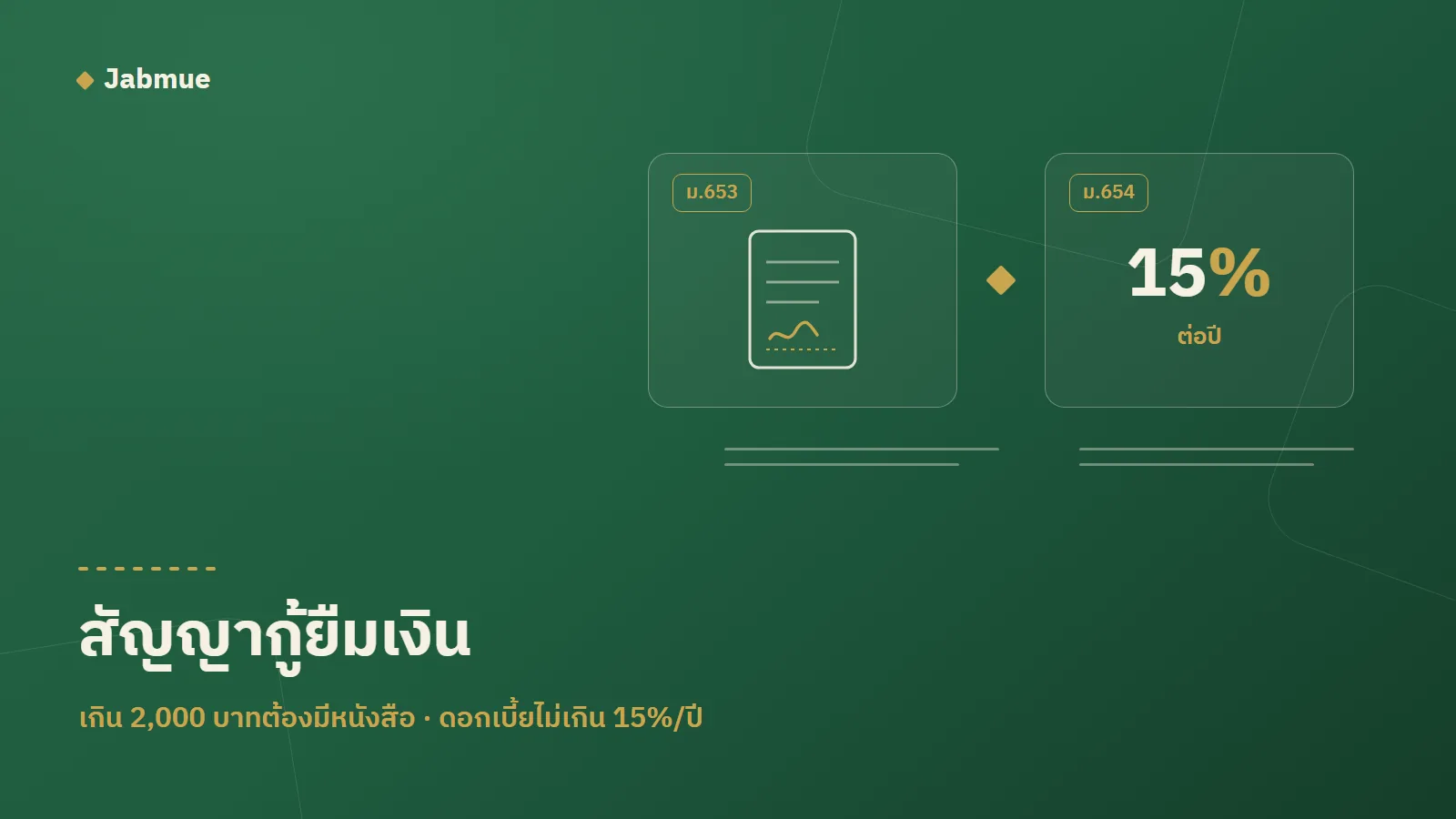
Lend more than ฿2,000 without written evidence signed by the borrower, and you lose the right to enforce the loan in court. The debt does not legally disappear, but you have no legal tool to recover the money if the borrower simply refuses to pay. And when you lend as a private individual, the interest you can charge has a hard ceiling too.
The most common scenario is lending money to a relative or friend "on trust," with no paperwork at all, or nothing more than a short chat exchange. This article covers the ฿2,000 threshold under Thai law, the lawful interest rate, the clauses every loan agreement (สัญญากู้ยืมเงิน) needs, stamp duty, and how to get the borrower to sign before you actually transfer the money.
TL;DR: Lending more than ฿2,000 without written evidence signed by the borrower means the loan is unenforceable in court (Section 653 of the Thai Civil and Commercial Code). The debt does not legally vanish, but you lose the right to use the courts to recover it. Between private individuals, interest is capped at 15% per year (Section 654); write a higher rate and the law automatically reduces it to 15%. Charging excessive interest also carries criminal penalties under the Prohibition of Charging Interest at Excessive Rates Act B.E. 2560 (2017). A loan agreement can be signed electronically under the Electronic Transactions Act B.E. 2544 (2001). (General information, not legal advice.)
Key Takeaways
- Over ฿2,000 requires written evidence signed by the borrower; without it, the loan cannot be enforced in court (Section 653)
- Interest between private individuals cannot exceed 15% per year; anything higher is automatically reduced to 15% (Section 654)
- Charging excessive interest also risks criminal penalties under the 2017 Act, separate from the civil consequences
- LINE chats discussing the loan may serve as supporting evidence, but "may not be clear enough" compared with a signed agreement
- A loan agreement can legally be signed electronically
- This article is general information, not legal advice for any specific case
Over ฿2,000 Must Be in Writing, or You Cannot Sue
The law requires that a loan of more than ฿2,000 be supported by written evidence signed by the borrower before it can be enforced in court (Section 653 of the Civil and Commercial Code). Without it, the loan is not void, but the lender has no way to use the courts to recover the money.
"Written evidence" here does not always mean a formal contract. Any document that proves a loan exists and carries the borrower's signature can qualify. A bare payment receipt that never mentions a loan, however, is usually not enough.
A point that confuses many people: a LINE chat in which the borrower admits to the loan may be usable as supporting evidence, but it "may not be clear enough" compared with a clearly signed agreement, because proving who typed the messages and whether the thread is complete is much harder.
Interest Is Capped at 15% Per Year — and What Happens If You Write More
Between private individuals, loan interest cannot exceed 15% per year (1.25% per month) under Section 654. If the contract states a higher rate, the law automatically reduces it to 15% per year; the rest of the agreement remains binding.
The statute is explicit that interest above the legal rate cannot be charged. Where a higher rate has been agreed, the excess portion is unenforceable, but the principal and interest within the legal rate can still be collected as normal.
Why Banks and Finance Companies Can Charge More Than 15%
The 15% annual cap applies to lending between private individuals who are not financial institutions. Banks, credit companies, and licensed micro-lenders operate under their own specific legislation, which sets separate interest ceilings.
This is where many people get confused: they assume the credit card or consumer loan rates they see advertised are the same standard that applies when lending to a relative. They are not. Licensed financial institutions are governed by specific laws entirely separate from Section 654.
Criminal Penalties for Charging Excessive Interest
On top of the civil consequence of interest being reduced to 15% per year, charging excessive interest is also a criminal offence under the Prohibition of Charging Interest at Excessive Rates Act B.E. 2560 (2017), which carries imprisonment and fines.
The Act covers both formal lending and informal, off-the-books lending, with an exception for financial institutions supervised under their own specific legislation.
The Clauses Every Loan Agreement Needs
A safe loan agreement needs at least 8 elements: full identification of both parties, the loan amount in both numbers and words, an interest rate no higher than 15% per year, the date the money is actually received, the repayment schedule, a guarantor (if any), late-payment penalties, and a repayment method that leaves a verifiable trail.
- Party identification — full names, ID card numbers, and addresses of both lender and borrower
- Loan amount — stated in both numbers and words to prevent later alteration
- Interest rate — no more than 15% per year, with a clear calculation method
- Date the money is received — the starting point of the obligation
- Repayment schedule — lump sum or instalments, with due dates
- Guarantor — if required, the guarantor must also sign the document
- Late-payment penalty — set at a reasonable rate
- Repayment method — bank transfer is recommended so there is proof of payment; cash without a receipt is not
Does a Loan Agreement Need Stamp Duty?
Loan agreements appear in the stamp duty schedule of the Thai Revenue Code and should carry stamp duty at the rate the law prescribes. The exact rate and cap should be checked with a tax advisor or the Revenue Department before relying on them, since the precise figures can change and should be confirmed from official sources.
Already Lent the Money With No Contract?
If you have already transferred the money without a contract, it is not too late. Having the borrower sign a debt acknowledgment letter is a way to create written evidence after the fact, and it may restart the limitation period. Read the full guide on how a debt acknowledgment differs from a loan agreement and what it must contain.
Can a Loan Agreement Be Signed Online?
Yes. Under the general principles of contract law, a loan agreement can be signed with an electronic signature under the Electronic Transactions Act B.E. 2544 (2001), which recognizes electronic documents and signatures as equivalent to paper — provided the method used is reliable and can be verified after the fact.
The most important point in practice is to have the borrower sign before you transfer the money, not after. The moment just before the money leaves your account is when both parties are most clearly in agreement. Sending a signing link with OTP identity verification and a recorded audit trail strengthens the evidentiary weight of the document — it is not an absolute, 100% legal guarantee.
Read the full guide to the legal validity of electronic signatures in Thailand
Frequently Asked Questions
The loan is exactly ฿2,000 — do I need a contract?
The legal threshold is "more than" ฿2,000. A loan of exactly ฿2,000 does not fall under the Section 653 requirement, but having written evidence is always good practice anyway.
The contract doesn't mention interest — can I still charge it?
This turns on the statutory interest rate that applies when no rate was agreed in advance, which is something to review with a legal advisor case by case.
Can a LINE chat where the borrower admits the loan be used as evidence?
It may serve as supporting evidence, but it "may not be clear enough" compared with a clearly signed agreement, because identity and message completeness are harder to prove.
Does the guarantor need to sign too?
Yes. If you want a guarantor on the loan, the guarantor must personally sign the document for the guarantee to be binding.
The contract says 3% per month — what happens?
3% per month equals 36% per year, which exceeds the 15% annual cap under Section 654. The law automatically reduces the rate to 15% per year, and collecting the excess also carries criminal risk under the 2017 Act.
Is an online-signed loan agreement legally valid?
Yes, under the Electronic Transactions Act B.E. 2544 (2001), provided the signing method is reliable and verifiable after the fact.
Summary
A safe loan agreement starts with knowing the ฿2,000 threshold, the 15% annual interest cap, and the complete set of clauses. Most important of all: have the borrower sign before you transfer the money, not after.
Try it free — create a loan agreement and send it for signature before you transfer
If the money has already been transferred without a contract, read how to prepare a debt acknowledgment letter to create evidence after the fact.
This content is general information, not legal advice for any specific case. Consult a legal advisor before using any contract.
What Is Stamp Duty in Thailand? Which Contracts Need It, and What to Do When You Sign Online (2026)
What is stamp duty, which contracts in Thailand need it, and do contracts signed online through a system like Jabmue still owe stamp duty? Plus how to pay electronic stamp duty (e-Stamp) through the Thai Revenue Department.
Read article →Can You Sign Documents via LINE? A Straight Answer (2026)
Can you sign documents via LINE? Yes, but sending a photo of a signature in chat and signing through an OTP-verified link carry very different legal weight. Here's the comparison.
Read article →Is Daily Condo Rental (Airbnb-Style) Legal in Thailand? What to Know Before Signing a Short-Term Rental Contract
Renting out a condo by the day, Airbnb-style, sits in a genuine legal grey zone in Thailand. The Hotel Act B.E. 2547 (2004) and condominium juristic person rules can both apply. This article explains the risks honestly, plus the clauses a short-term rental contract should include.
Read article →Service Agreement in Thailand: Hire of Work vs Employment Contract, What Actually Changes
A Thai service agreement (hire of work) and an employment contract look similar, but the tax and legal consequences are very different. See the 6 clauses every B2B service agreement needs, plus the points Thai businesses miss most often.
Read article →Rental Security Deposit in Thailand: When It Must Be Returned, What Can Be Deducted, and the Refund Letter
When must a rental security deposit be returned in Thailand? What deductions are lawful, what tenants can do if it isn't returned, and the deposit refund letter every landlord should use — with a ready-made template.
Read article →Thai Receipt Template: How It Differs from e-Tax Invoice, and What Jabmue Can (and Can't) Do
An ordinary receipt and the Revenue Department's e-Tax Invoice are not the same document. This article explains the difference, and says it plainly: Jabmue can create and sign electronic receipts, but it is not an e-Tax Invoice system that files directly with the Revenue Department.
Read article →Quotation Template Thailand: What to Include, Is It Binding, and Can Clients Accept Online?
Quotation template for Thailand: the elements every quote needs, itemized pricing, 7% VAT, validity period, how a quote differs from a purchase order, and how to get clients to sign their acceptance online.
Read article →Property Purchase Agreement + Deposit in Thailand: What to Check Before You Sign
Thailand's agreement to purchase and sell explained: the deposit terms, the clauses it must contain, what happens on breach, and how it differs from the ownership transfer at the Land Department.
Read article →Thailand's Draft ETA Amendment (2026): What Could Change
ETDA is seeking public comment on a draft ETA amendment. This is still a draft, not law in force yet: here's what it proposes and the latest status.
Read article →PDPA for Real Estate Agents: How to Collect Tenant and Buyer Data Legally
How real estate agents can collect tenant and buyer data in line with the PDPA — a practical checklist, plus what to watch out for when asking for ID card copies
Read article →Is a Pasted Signature Image in a PDF Valid? How It Differs from a Real E-Signature (2026)
Is a pasted signature image in a PDF valid? It works in practice, but it is not an electronic signature in the legal sense. Here's the difference, and the risks you should know before using one.
Read article →Is an MOU Legally Binding in Thailand? The Honest Answer Is "It Depends", and Here's How to Check
Many people assume an MOU is never legally binding. In some cases, though, a Thai court may read an MOU as an enforceable contract. Learn the 4 things that make an MOU binding by accident, and how to draft one that matches what you actually intend.
Read article →NDA in Thailand: Template, Key Clauses and E-Signing
A sample NDA for Thai businesses: essential clauses, fair duration, penalties courts won't reduce, and how it differs from PDPA. Ready-to-sign template.
Read article →Jabmue vs zDOX: 2026 Comparison (Generic Templates or Ready-to-Use Thai Legal Contracts)
Jabmue vs zDOX compared: per-user pricing, Thai legal contract templates, LINE bot, NDID, and PromptPay (prices verified Aug 2026)
Read article →Jabmue vs eSigns.cloud: 2026 Comparison (Tax-Audit Readiness or an All-in-One Contract Tool)
Jabmue vs eSigns.cloud compared: pricing, document editor, Thai legal templates, e-Tax XML, and PromptPay (prices verified Aug 2026).
Read article →Jabmue vs DocuSign (2026): Which E-Signature Tool Fits Your Thailand Operations?
Jabmue vs DocuSign compared for companies operating in Thailand: pricing, Thai-language support, PromptPay, LINE, and legal templates. Verified August 2026.
Read article →Best E-Signature Tools in Thailand (2026): Pricing, Features, and the Right Pick for Your Business
Compare Jabmue, eSigns.cloud, zDOX, Veracity, and 5 more: real pricing, Thai legal templates, PromptPay, and LINE support — pricing verified Aug 2026
Read article →Real Estate Broker Agreement in Thailand: Protect Your Commission
Real estate broker agreement Thailand sample with explanation: Thai law doesn't require it in writing, but in practice, without written proof, claiming your commission is extremely difficult. References Sections 845-846 of the Civil and Commercial Code, plus a ready-to-use exclusive listing agreement template.
Read article →PDPA Checklist for Clinics in Thailand: 9 Obligations, 9 Documents
PDPA checklist for clinics in Thailand: how patient data consent works, whether you need a DPO, and what documents you actually need — with templates ready to sign.
Read article →Are Electronically Signed Documents Admissible in Thai Courts? FAQ (Updated 2026)
Are electronically signed documents admissible in Thai courts? The short answer is yes, with conditions, under the Electronic Transactions Act B.E. 2544 (2001) — with real Supreme Court decisions and ways to strengthen reliability using OTP and an audit trail.
Read article →Lease Termination Notice in Thailand: Templates and Legal Steps
What must a lease termination notice and overdue rent demand letter include? Read the steps under Sections 560/566 of the Civil and Commercial Code, with the correct structure and provable delivery methods (Updated 2026).
Read article →The HR Documents You'll Issue Most Often in Thailand: Warning Letters, Resignation Letters, Employment Certificates
Warning letters, resignation letters, and employment certificates are the 3 HR documents Thai SMEs issue most often, and getting them wrong creates real legal problems. Learn how long a warning letter stays valid, the real resignation notice rules, and what employers are legally required to issue.
Read article →How to Send a Document for Online Signature in 10 Minutes (With Real Screenshots)
Send a document for online signature in 10 minutes — no printing, no scanning, no account needed for the signer, with real screenshots of every step
Read article →Debt Acknowledgment in Thailand: What It Is, How It Differs From a Loan Agreement, and How the Limitation Period Resets
What is a debt acknowledgment letter in Thailand? How it differs from a loan agreement, how it interrupts and resets the limitation period, whether witnesses are required, what it must say, and how to sign it online.
Read article →Can AI Draft a Contract? What the Risks Are (A Straight Answer for 2026)
Can AI like ChatGPT or Gemini draft a contract? Yes, but there are risks you need to know: legal references that may be outdated, potentially unfair contract terms, and the fact that AI-written text is not a legally binding document.
Read article →Power of Attorney in Thailand: Which Form for Which Use?
Power of Attorney Thailand: which form for which use? This guide maps every POA type, Land Office to general business, and what is e-signable.
Read article →PDPA Consent Form Generator: Beyond the Cookie Banner
Most PDPA consent form generators only cover cookies. Build a printable, bilingual consent form for Thai clinics and SMEs, free templates included.
Read article →Notary Public in Thailand vs. E-Signature: What Foreigners Need
Thailand has no Western-style notary public, only Notarial Services Attorneys. Here's when you actually need one and when a legally valid e-signature is enough.
Read article →Is E-Signature Legal in Thailand? The Complete Guide to Thai Law (2026 Update)
Is an electronic signature legal in Thailand? Yes — under the Electronic Transactions Act B.E. 2544 (2001). Full guide: signature types, court evidence, exceptions, and the 2026 draft law.
Read article →Freelance Contract in Thailand: From LINE Chats to a Signed Agreement
Freelancers in Thailand have no labor-law protection. See the 8 clauses your contract needs, and how to turn LINE chats into a signed agreement.
Read article →Employment Contract in Thailand: Template and E-Signing Guide
A ready-to-use bilingual Thai-English employment contract template, with a legally compliant e-signing process via OTP and audit trail, plus a staff NDA.
Read article →Electronic Signature vs Digital Signature in Thailand (2026)
Electronic signature (Section 9) vs digital signature (Sections 26-28) under Thai law: which one your business actually needs, with a comparison table.
Read article →How Secure Are Electronic Signatures? An Honest Answer
How secure are electronic signatures? An honest look at what OTP and an audit trail protect, what they don't, and how to spot fake signing links.
Read article →Condo Lease Agreement in Thailand (Thai-English): Complete Guide
A ready-to-use Thai-English condo lease agreement you can fill in and sign online with OTP, valid under Thai law (Electronic Transactions Act B.E. 2544 (2001)). No printing or scanning required — plus a clear explanation of when leases over 3 years must be registered.
Read article →Digital Informed Consent for Aesthetic and Dental Clinics in Thailand
What must a valid informed consent form include? A guide for aesthetic and dental clinics in Thailand: legally required content, how to separate it from PDPA consent, and how to digitize it without legal risk.
Read article →Certified True Copies in Thailand: Can You Sign Them Online?
Can you sign a certified true copy online in Thailand? A straight answer on when e-signatures work, when you still need wet ink, and how to certify safely.
Read article →Documents for Accounting Firms: Tax Filing Power of Attorney, Engagement Letters, and the Paperwork That Comes Back Every Month
The tax filing power of attorney, engagement letter, and other documents Thai accounting firms handle every month — plus how to get clients to sign online without printing anything
Read article →Ready to stop chasing paper signatures?
Start your free 14-day trial — no credit card required.