

Are Electronically Signed Documents Admissible in Thai Courts? FAQ (Updated 2026)
Yes, with conditions. That's the direct answer to a question nobody has clearly answered yet.
On the Thai forum Pantip, thread #39853903, someone asked this exact question: can a document signed online actually be used as evidence in court? But the thread never got an answer from an actual expert — just guesswork from ordinary users. And that reflects a real problem faced by a lot of business owners.
Whether it's a real estate agent sending a lease for a client to sign on their phone, a clinic having patients sign consent forms online before a procedure, or an SME sending a quote for a client to approve by email — everyone asks the same question: if a dispute actually arises one day, how much protection does a document signed on a screen really offer?
This article answers that question clearly, with real legal grounding, citable Supreme Court decisions, and what separates a document that's merely "admissible" from one that's "hard to dispute."
Read the full guide to online document signing law in Thailand
Quick summary: Yes, with conditions. Thai law prohibits courts from refusing to admit electronic evidence just because it's digital data (Section 11 of the Electronic Transactions Act B.E. 2544 (2001)), and the Supreme Court has previously accepted chat messages and electronic identity verification as evidence (Decision No. 8089/2556 (2013), Decision No. 6757/2560 (2017)). But "admissible" is not the same as "having enough weight to win a case." Courts assess reliability based on how the document was created, stored, and how the signer's identity was verified. The more identity-verification trail there is — such as OTP codes and a complete audit trail of document changes — the harder it is to dispute forgery or impersonation. But no system can guarantee a case outcome 100%.
Key Takeaways
- Electronic documents are admissible as a general rule in Thai courts. Under Section 11, courts cannot reject them purely because they're in digital form.
- Four core sections support e-signatures: Section 7 (legal effect), Section 8 (satisfies written-evidence requirements), Section 9 (satisfies signature requirements), and Section 11 (admissibility as evidence).
- The Supreme Court has upheld digital evidence in two real cases: Decision No. 8089/2556 (2013) and Decision No. 6757/2560 (2017).
- The most common misunderstanding: "admissible" does not equal "enough evidentiary weight to win." What actually matters is your ability to prove who signed and that the document hasn't been altered.
- OTP verification and an audit trail strengthen the reliability of your evidence — but they are not a guarantee of the case outcome.
- There are legal exceptions — such as land sale/transfer and leases that must be registered (over 3 years) — which still have to go through the paper-based process at the Land Department.
Last updated: August 2026. This article is reviewed at least once a year to reflect changes in the law and new case law.
Can Online Document Signatures Really Be Used as Evidence in Thai Courts? (The Direct Answer)
Yes. Electronic documents signed online can be used as evidence in Thai court proceedings, because the law prohibits courts from refusing to admit evidence purely because it's in digital form.
The heart of this answer lies in Section 11 of the Electronic Transactions Act B.E. 2544 (2001), which states clearly:
"Electronic data shall not be denied admissibility as evidence in legal proceedings solely on the grounds that it is electronic data."
In plain terms: a court has no right to throw out a contract you signed on your phone, or a purchase order you approved by email, just because it isn't a physical piece of paper with wet-ink signatures.
This section breaks down into three key parts: admissibility is a general principle that courts must uphold; the reliability of the data is assessed based on how it was created, stored, and kept intact; and equal value is given to the original electronic data and to any printout properly reproduced from it.
This isn't just theory. Thailand's justice system has already been adapting to accommodate digital evidence for some time. The Civil Court opened a division for online trading disputes that accepts filings 24 hours a day through the CIOS system, under the Supreme Court President's Regulation on Electronic Case Proceedings B.E. 2563 (2020) (Bangkok Biznews).
That means the court system itself was already designed to handle disputes arising from online transactions — this isn't some exception that has to be argued for on a case-by-case basis.
The volume of disputes tied to online transactions isn't small, either. ETDA's 1212 online complaint center received 39,112 complaints in 2025, up 10.62% from the previous year, and online trading has remained the top complaint category for three consecutive years, accounting for 14,238 cases, or 36.40% of the total (ETDA — 1212 Center Statistics).
What does this number tell us? It tells us that digital transactions and documents are entering Thailand's justice system in growing volumes every year, and the question of how reliable digital evidence is isn't just an academic question anymore — it's something business owners need to understand correctly from day one of using these tools.

Where Does Thai Law Actually Support Electronic Signatures? (Sections 7, 8, 9, 11)
There's no single section that "covers everything." Thai law supports electronic signatures through four sections that each play a different role — from legal effect to admissibility as evidence.
The Electronic Transactions Act B.E. 2544 (2001) lays out its framework in layers, as follows:
| Section | What It Covers | Why It Matters for Online-Signed Documents |
|---|---|---|
| Section 7 | Data or contracts in electronic form are not denied legal effect merely because they're in that format | Makes contracts made through an online system just as binding as paper contracts — not merely a "loose agreement" |
| Section 8 | Where the law requires written evidence, accessible and verifiable electronic data whose content hasn't been altered is deemed to satisfy that requirement | Documents that legally require "written evidence" can exist as a fully preserved digital file |
| Section 9 | Where the law requires a signature, an electronic method that reliably identifies the owner of the signature is deemed to satisfy that requirement | This is the section that gives an "electronic signature" the same status as a handwritten one, provided the signer can be reliably identified |
| Section 11 | Admissibility of electronic data as evidence in court proceedings | The section that actually allows digital documents into the courtroom in practice |
Notice that Sections 7, 8, and 9 work together to give electronic documents and signatures a "legal status" equivalent to paper documents and wet-ink signatures, while Section 11 opens the door for those documents to actually be used as evidence when a dispute arises. All four sections work together — no single section answers the whole question on its own. This approach has been confirmed by multiple independent sources, including ETDA itself (ETDA — Can Online Documents Be Used as Evidence?) and law firms specializing in this area (Srisung Law, Dharmniti).
⚠️ Legal accuracy note: This article references only Sections 7, 8, 9, and 11, which have been consistently confirmed across multiple independent sources. It has not been confirmed against the original statutory text whether other sections should also be included regarding admissibility of evidence. If you need legal advice for a specific situation, consult a qualified professional who has reviewed the latest consolidated version of the law.
Compare online document signing platforms in Thailand 2026
Has the Supreme Court Actually Ruled on This? (Citable Case Law)
Yes. There are at least two Supreme Court decisions directly relevant to the principle of admitting digital evidence and electronic identity verification. Neither case addresses "electronic signatures" in the exact sense that e-signature systems use today, but both establish principles that can reasonably be applied by analogy.
Supreme Court Decision No. 8089/2556 (2013): The Supreme Court applied the Electronic Transactions Act and accepted that withdrawing cash from an ATM using a PIN, together with the transaction slip, could serve as evidence of a loan. The principle established in this case can be compared to situations involving electronic identity verification systems — for example, an OTP code performing the same role a handwritten signature would, in confirming who actually carried out a transaction.
Supreme Court Decision No. 6757/2560 (2017): A message forgiving a debt, sent via Facebook Messenger and clearly identifying the sender's account name, was accepted as complete written evidence of debt discharge.
Neither case (Legardy — E-Signature Legal Guide; corroborated by Bangkok Biznews) means that courts will automatically recognize every e-signature system out there. But what these cases do show is a principle the Supreme Court has consistently upheld: courts will accept digital evidence as long as the identity of the party involved in a transaction can be reasonably established, regardless of what form the evidence takes. This is exactly the principle a well-designed online signing system should be built around — making it as clear as possible who the signer actually is.
"Admissible" vs. "Enough Evidentiary Weight to Win": What's the Difference? (Where Most People Get It Wrong)
This is where most people get confused. The law confirms that electronic documents are "admissible" in nearly every case — but the "evidentiary weight" needed to actually win a case depends on your ability to prove who signed it, when they signed it, and that the document wasn't altered afterward.
Section 11, paragraph two, sets out clear guidance: when a court assesses the reliability of electronic data, it looks at three main factors — the method by which the data was created and stored, the completeness and integrity of the content, and the method used to identify the sender.
In plain terms, the court doesn't just ask "is this a digital document?" — it asks "how reliable is this document as evidence?" (ETDA, Srisung Law)
A clear example is LINE chat messages. In practice, Thai courts have accepted chat messages as evidence of a loan before — but the party relying on the messages has to prove, through additional circumstantial factors, that the LINE account actually belongs to the other party. This might include how long the account has been in use, personal posts that link back to that person's identity, or a familiar pattern in how they write. That's an extra burden to carry, because chat messages alone may not be clear enough on their own to establish who the sender actually is, without supporting circumstantial evidence.
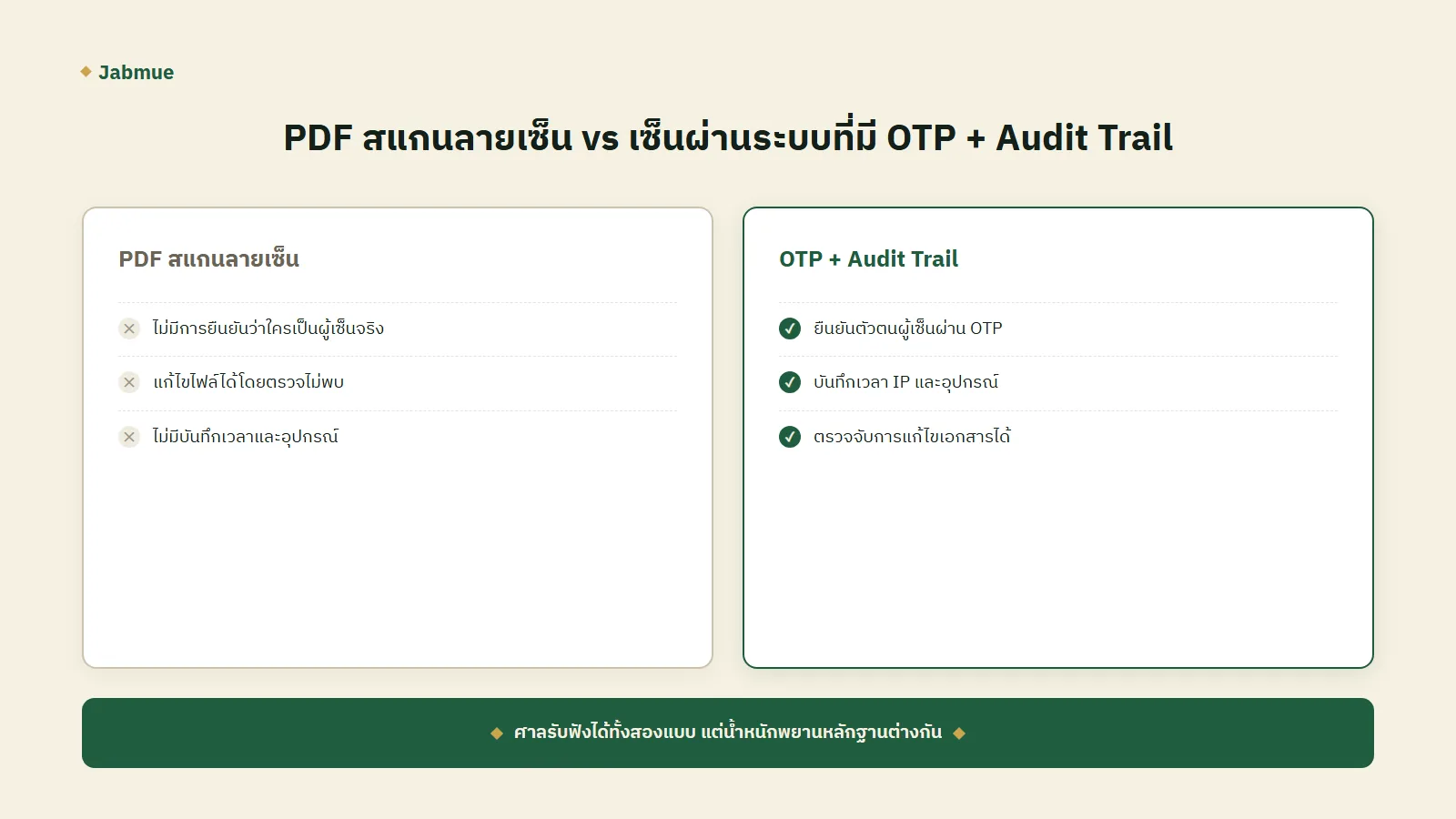
The comparison table below shows the difference between two types of documents that are "equally admissible" but have "very different evidentiary weight."
| Factor | Scanned-Signature PDF | Document Signed via OTP + Audit Trail |
|---|---|---|
| Admissibility as evidence | Admissible under Section 11 | Admissible under Section 11 |
| Proving the signer's identity | Difficult — usually requires additional proof via witnesses or circumstantial evidence | Identity-verification trail via the phone number or email tied to the OTP |
| Checking whether the document was altered | Difficult to verify — a PDF file can be edited and rescanned | Timestamped record of the document and any changes throughout the process |
| Burden of proof if challenged | High — the party relying on the document must prove almost everything itself | Lower, since the records help confirm both integrity and identity |
| Overall evidentiary weight | Lower, even though it's equally "admissible" | Higher, because it more directly satisfies the reliability criteria under Section 11, paragraph two |
Another interesting piece of context: electronic signature adoption is growing rapidly worldwide. The global e-signature market was valued at approximately USD 4.0 billion in 2021 and is projected to grow to roughly USD 14.1 billion by 2026, at a compound annual growth rate of more than 28% (MarketsAndMarkets — Digital Signature Market Report). Some sources estimate the market could reach USD 70.24 billion by 2030, at a compound annual growth rate of 38.5% from 2024–2030 (Polaris Market Research). These figures are global, not Thailand-specific — but they reflect a trend of businesses worldwide shifting toward digital document signing, and the reliability of this type of evidence will only become more important going forward.
What Do OTP Verification and an Audit Trail Actually Add?
OTP verification and an audit trail don't "guarantee" that you'll win a case — but they help eliminate the most common objections from the outset, such as claims that someone else signed on your behalf, denial that a document was ever signed at all, or claims that a document was altered after it was signed.
Let's revisit the reliability criteria set out in Section 11: how the data was created and stored, whether the content remains intact and unaltered, and how the sender was identified. A detailed, timestamped audit trail directly addresses all three of these criteria, because it records data such as the IP address, the device used to sign, the time the OTP code was sent and confirmed, and a hash value of the document at the exact moment it was signed — a value that changes instantly if the document is altered by even a single character. Having these records means that when a dispute arises, the party holding the document can present tangible evidence, instead of relying purely on verbal claims.
The need for this is even clearer when you look at Thailand's cybercrime statistics. Between January 1 and February 12, 2025, 43,217 cybercrime cases were reported, with damages estimated at approximately 3.43 billion baht (Thai PBS). At the same time, Thailand's digital economy continues to grow — Thai e-commerce reached 5.96 trillion baht in 2023, with the insurance sector growing fastest at 31% (ETDA — Digital Economy e-Commerce Survey) — and in terms of data privacy, complaints related to personal data protection accounted for 6.15%, or 2,407 cases, out of ETDA's total complaints in 2025 (ETDA — 1212 Center Statistics). This is directly relevant to businesses such as clinics that handle patients' health data, which need systems with an identity-verification trail and traceable data storage even more than most.
⚠️ Caution: No matter how full-featured an online document signing system is, no system in the world can "guarantee" you'll win a case. OTP verification and an audit trail serve to strengthen and reduce common objections — they don't prevent every possible dispute. The final decision still rests with the court's discretion in each individual case.

If you're considering moving away from paper signatures or sending scanned-signature PDFs over LINE, and toward a system with complete identity verification built in, this is where to start. Try jabmue free for 14 days and see a real audit trail example
Which Documents Can't Be Signed Online, or Have Exceptions?
Most documents can be signed online — but there are exceptions under the Royal Decree on Electronic Transactions Criteria and Procedures B.E. 2549 (2006), particularly for documents legally required to be registered with a government authority, and certain documents related to family and inheritance law.
The most important exception for real-estate-related businesses is the sale or transfer of land ownership, and property leases with a term exceeding 3 years, which must be registered at the Land Department. These types of documents still have to go through the traditional paper-based process (this is based on consistent secondary sources — you should verify this against the official statutory text before relying on it for a specific situation).
For real estate agents, this is the line worth remembering: short-term leases of 3 years or less don't need to be registered, which makes them a great fit for online signing. Condo leases, house rentals, or short-term commercial space leases can all be handled fully through an online document signing system. But for land sales or long-term leases requiring registration, that process still has to happen at the Land Department, following the standard paper-based steps.
Lease signing system for real estate agents
For clinics using electronic consent forms for clinics or informed consent, our research found no legal exception specifically prohibiting the use of an electronic format for this type of document. That said, for high-risk or complex procedures, extra caution is recommended. This is a practical recommendation, not a specific legal rule found in our research. Clinics that want maximum assurance should consult their own legal advisor before relying on electronic consent for high-risk procedures.
This article provides general information for educational purposes only. It is not specific legal advice. If you have a dispute or a specific situation requiring clarity, you should consult a lawyer or legal advisor who can review the facts and the latest version of the relevant statutes directly.
More Frequently Asked Questions
Can LINE chat messages be used as evidence in court?
Yes. Thai courts have accepted LINE messages as evidence of a loan in practice before, but the party relying on those messages has to prove, through additional circumstantial factors, that the LINE account actually belongs to the other party — such as how long the account has been in use and personal posts that link back to that person's identity. Without supporting circumstantial evidence, chat messages alone may be harder to attribute clearly enough to confirm who the sender was.
Can an electronic signature be forged?
Technically, an electronic signature backed by an identity verification system such as OTP is harder to forge than a wet-ink signature on paper, because it comes with identity verification and digital records at every step. Legally, however, the party claiming a signature is forged carries the same burden of proof as they would for a paper signature — there's no special exemption or additional burden either way.
Does the Thai court system already have infrastructure to handle cases involving electronic evidence?
Yes. The Civil Court has opened a division for online trading disputes that accepts filings 24 hours a day through the CIOS system, under the Supreme Court President's Regulation on Electronic Case Proceedings B.E. 2563 (2020) — showing that the court system was already designed to handle disputes arising from online transactions.
Do online-signed documents need to be printed and kept on paper?
Not necessarily. Under the law, Section 11 gives the original digital document the same value as a paper original. In practice, however, it's still a good idea to back up your document files in multiple places for security and ease of access when needed.
Summary
A document you sign online through your phone or computer can be used as evidence in Thai courts. This is no longer a gray area. The key points to remember are:
- The answer is yes, with conditions, under Section 11 of the Electronic Transactions Act B.E. 2544 (2001).
- Sections 7, 8, 9, and 11 work together, covering everything from legal effect and written evidence to signature requirements and admissibility as evidence.
- The Supreme Court has upheld digital evidence in comparable situations before — in both Decision No. 8089/2556 (2013) and Decision No. 6757/2560 (2017).
- The real question isn't "is it admissible?" but "does it carry enough evidentiary weight to win?" — which depends on proving who signed and that the document remained intact.
- OTP verification and an audit trail help strengthen reliability and reduce objections around impersonation or alteration — but they are not a guarantee of the case outcome.
- There are important exceptions, such as land sale/transfer and leases requiring registration, which must still go through the paper-based process.
If your business is sending leases, quotes, or consent forms for clients to sign through a channel with no identity verification at all, now's the time to switch to a system designed from the ground up to meet Thai law's reliability standards.
Try jabmue free for 14 days or View jabmue plans and pricing — and if your legal or operations team wants to see a detailed audit trail example before deciding, you can book a demo with the jabmue team to see a real audit trail example
This article provides general information for educational purposes only and does not constitute specific legal advice. For your own dispute or particular situation, consult a lawyer or legal advisor directly.
What Is Stamp Duty in Thailand? Which Contracts Need It, and What to Do When You Sign Online (2026)
What is stamp duty, which contracts in Thailand need it, and do contracts signed online through a system like Jabmue still owe stamp duty? Plus how to pay electronic stamp duty (e-Stamp) through the Thai Revenue Department.
Read article →Can You Sign Documents via LINE? A Straight Answer (2026)
Can you sign documents via LINE? Yes, but sending a photo of a signature in chat and signing through an OTP-verified link carry very different legal weight. Here's the comparison.
Read article →Is Daily Condo Rental (Airbnb-Style) Legal in Thailand? What to Know Before Signing a Short-Term Rental Contract
Renting out a condo by the day, Airbnb-style, sits in a genuine legal grey zone in Thailand. The Hotel Act B.E. 2547 (2004) and condominium juristic person rules can both apply. This article explains the risks honestly, plus the clauses a short-term rental contract should include.
Read article →Service Agreement in Thailand: Hire of Work vs Employment Contract, What Actually Changes
A Thai service agreement (hire of work) and an employment contract look similar, but the tax and legal consequences are very different. See the 6 clauses every B2B service agreement needs, plus the points Thai businesses miss most often.
Read article →Rental Security Deposit in Thailand: When It Must Be Returned, What Can Be Deducted, and the Refund Letter
When must a rental security deposit be returned in Thailand? What deductions are lawful, what tenants can do if it isn't returned, and the deposit refund letter every landlord should use — with a ready-made template.
Read article →Thai Receipt Template: How It Differs from e-Tax Invoice, and What Jabmue Can (and Can't) Do
An ordinary receipt and the Revenue Department's e-Tax Invoice are not the same document. This article explains the difference, and says it plainly: Jabmue can create and sign electronic receipts, but it is not an e-Tax Invoice system that files directly with the Revenue Department.
Read article →Quotation Template Thailand: What to Include, Is It Binding, and Can Clients Accept Online?
Quotation template for Thailand: the elements every quote needs, itemized pricing, 7% VAT, validity period, how a quote differs from a purchase order, and how to get clients to sign their acceptance online.
Read article →Property Purchase Agreement + Deposit in Thailand: What to Check Before You Sign
Thailand's agreement to purchase and sell explained: the deposit terms, the clauses it must contain, what happens on breach, and how it differs from the ownership transfer at the Land Department.
Read article →Loan Agreement in Thailand: Over ฿2,000 Needs Written Evidence, Interest Capped at 15%/Year
What must a Thai loan agreement include? Loans over ฿2,000 need signed written evidence (Section 653), interest is capped at 15% per year (Section 654), plus stamp duty and how to sign online.
Read article →Thailand's Draft ETA Amendment (2026): What Could Change
ETDA is seeking public comment on a draft ETA amendment. This is still a draft, not law in force yet: here's what it proposes and the latest status.
Read article →PDPA for Real Estate Agents: How to Collect Tenant and Buyer Data Legally
How real estate agents can collect tenant and buyer data in line with the PDPA — a practical checklist, plus what to watch out for when asking for ID card copies
Read article →Is a Pasted Signature Image in a PDF Valid? How It Differs from a Real E-Signature (2026)
Is a pasted signature image in a PDF valid? It works in practice, but it is not an electronic signature in the legal sense. Here's the difference, and the risks you should know before using one.
Read article →Is an MOU Legally Binding in Thailand? The Honest Answer Is "It Depends", and Here's How to Check
Many people assume an MOU is never legally binding. In some cases, though, a Thai court may read an MOU as an enforceable contract. Learn the 4 things that make an MOU binding by accident, and how to draft one that matches what you actually intend.
Read article →NDA in Thailand: Template, Key Clauses and E-Signing
A sample NDA for Thai businesses: essential clauses, fair duration, penalties courts won't reduce, and how it differs from PDPA. Ready-to-sign template.
Read article →Jabmue vs zDOX: 2026 Comparison (Generic Templates or Ready-to-Use Thai Legal Contracts)
Jabmue vs zDOX compared: per-user pricing, Thai legal contract templates, LINE bot, NDID, and PromptPay (prices verified Aug 2026)
Read article →Jabmue vs eSigns.cloud: 2026 Comparison (Tax-Audit Readiness or an All-in-One Contract Tool)
Jabmue vs eSigns.cloud compared: pricing, document editor, Thai legal templates, e-Tax XML, and PromptPay (prices verified Aug 2026).
Read article →Jabmue vs DocuSign (2026): Which E-Signature Tool Fits Your Thailand Operations?
Jabmue vs DocuSign compared for companies operating in Thailand: pricing, Thai-language support, PromptPay, LINE, and legal templates. Verified August 2026.
Read article →Best E-Signature Tools in Thailand (2026): Pricing, Features, and the Right Pick for Your Business
Compare Jabmue, eSigns.cloud, zDOX, Veracity, and 5 more: real pricing, Thai legal templates, PromptPay, and LINE support — pricing verified Aug 2026
Read article →Real Estate Broker Agreement in Thailand: Protect Your Commission
Real estate broker agreement Thailand sample with explanation: Thai law doesn't require it in writing, but in practice, without written proof, claiming your commission is extremely difficult. References Sections 845-846 of the Civil and Commercial Code, plus a ready-to-use exclusive listing agreement template.
Read article →PDPA Checklist for Clinics in Thailand: 9 Obligations, 9 Documents
PDPA checklist for clinics in Thailand: how patient data consent works, whether you need a DPO, and what documents you actually need — with templates ready to sign.
Read article →Lease Termination Notice in Thailand: Templates and Legal Steps
What must a lease termination notice and overdue rent demand letter include? Read the steps under Sections 560/566 of the Civil and Commercial Code, with the correct structure and provable delivery methods (Updated 2026).
Read article →The HR Documents You'll Issue Most Often in Thailand: Warning Letters, Resignation Letters, Employment Certificates
Warning letters, resignation letters, and employment certificates are the 3 HR documents Thai SMEs issue most often, and getting them wrong creates real legal problems. Learn how long a warning letter stays valid, the real resignation notice rules, and what employers are legally required to issue.
Read article →How to Send a Document for Online Signature in 10 Minutes (With Real Screenshots)
Send a document for online signature in 10 minutes — no printing, no scanning, no account needed for the signer, with real screenshots of every step
Read article →Debt Acknowledgment in Thailand: What It Is, How It Differs From a Loan Agreement, and How the Limitation Period Resets
What is a debt acknowledgment letter in Thailand? How it differs from a loan agreement, how it interrupts and resets the limitation period, whether witnesses are required, what it must say, and how to sign it online.
Read article →Can AI Draft a Contract? What the Risks Are (A Straight Answer for 2026)
Can AI like ChatGPT or Gemini draft a contract? Yes, but there are risks you need to know: legal references that may be outdated, potentially unfair contract terms, and the fact that AI-written text is not a legally binding document.
Read article →Power of Attorney in Thailand: Which Form for Which Use?
Power of Attorney Thailand: which form for which use? This guide maps every POA type, Land Office to general business, and what is e-signable.
Read article →PDPA Consent Form Generator: Beyond the Cookie Banner
Most PDPA consent form generators only cover cookies. Build a printable, bilingual consent form for Thai clinics and SMEs, free templates included.
Read article →Notary Public in Thailand vs. E-Signature: What Foreigners Need
Thailand has no Western-style notary public, only Notarial Services Attorneys. Here's when you actually need one and when a legally valid e-signature is enough.
Read article →Is E-Signature Legal in Thailand? The Complete Guide to Thai Law (2026 Update)
Is an electronic signature legal in Thailand? Yes — under the Electronic Transactions Act B.E. 2544 (2001). Full guide: signature types, court evidence, exceptions, and the 2026 draft law.
Read article →Freelance Contract in Thailand: From LINE Chats to a Signed Agreement
Freelancers in Thailand have no labor-law protection. See the 8 clauses your contract needs, and how to turn LINE chats into a signed agreement.
Read article →Employment Contract in Thailand: Template and E-Signing Guide
A ready-to-use bilingual Thai-English employment contract template, with a legally compliant e-signing process via OTP and audit trail, plus a staff NDA.
Read article →Electronic Signature vs Digital Signature in Thailand (2026)
Electronic signature (Section 9) vs digital signature (Sections 26-28) under Thai law: which one your business actually needs, with a comparison table.
Read article →How Secure Are Electronic Signatures? An Honest Answer
How secure are electronic signatures? An honest look at what OTP and an audit trail protect, what they don't, and how to spot fake signing links.
Read article →Condo Lease Agreement in Thailand (Thai-English): Complete Guide
A ready-to-use Thai-English condo lease agreement you can fill in and sign online with OTP, valid under Thai law (Electronic Transactions Act B.E. 2544 (2001)). No printing or scanning required — plus a clear explanation of when leases over 3 years must be registered.
Read article →Digital Informed Consent for Aesthetic and Dental Clinics in Thailand
What must a valid informed consent form include? A guide for aesthetic and dental clinics in Thailand: legally required content, how to separate it from PDPA consent, and how to digitize it without legal risk.
Read article →Certified True Copies in Thailand: Can You Sign Them Online?
Can you sign a certified true copy online in Thailand? A straight answer on when e-signatures work, when you still need wet ink, and how to certify safely.
Read article →Documents for Accounting Firms: Tax Filing Power of Attorney, Engagement Letters, and the Paperwork That Comes Back Every Month
The tax filing power of attorney, engagement letter, and other documents Thai accounting firms handle every month — plus how to get clients to sign online without printing anything
Read article →Ready to stop chasing paper signatures?
Start your free 14-day trial — no credit card required.