

Is a Pasted Signature Image in a PDF Valid? How It Differs from a Real E-Signature (2026)
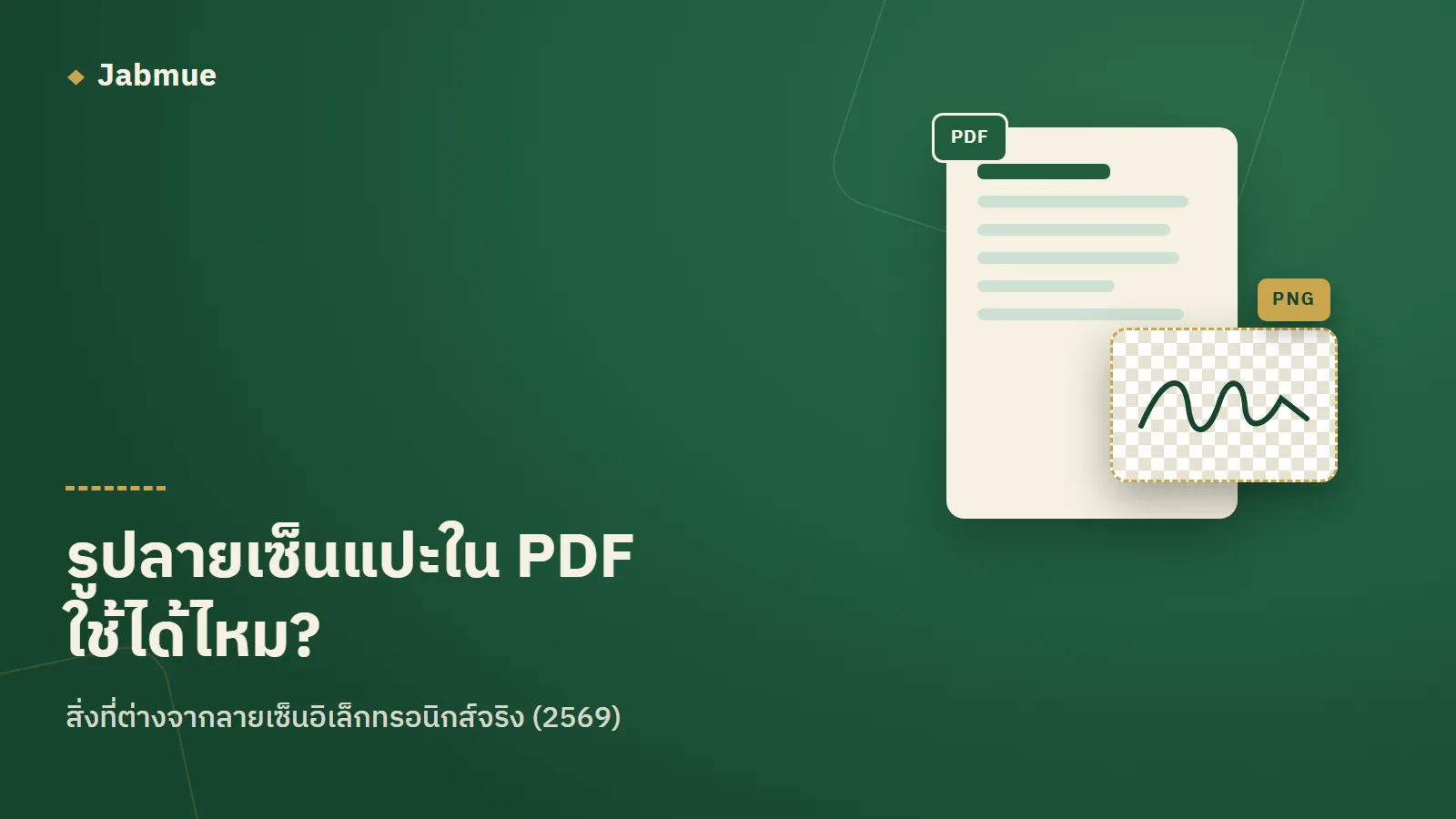
Pasting a signature image into a PDF is technically doable, but it is not an "electronic signature" within the meaning of Thai law, because it is merely an image that anyone can copy into another document, with no identity verification and no timestamp showing who actually placed it. That is different from an electronic signature under Section 9 of the Electronic Transactions Act B.E. 2544 (2001), which must reliably identify the signer and show their intent. A pasted signature image therefore carries far less legal weight, especially when a dispute arises.
If you have been saving your own signature as a PNG file and pasting it into documents all along, this article is written specifically for you. Not to tell you the method is wrong, but to explain clearly how it differs from an electronic signature, and when each is appropriate.
TL;DR: Pasting a signature image into a PDF is technically doable, but it is not an electronic signature in the legal sense, because it is an image file that can be copied and reused, with no identity verification or timestamp attached. That is different from an electronic signing system that can verify identity under Section 9.
What you should know
- A signature image pasted into a PDF is just an image file, not an electronic signature in the legal sense.
- The main risk is the image file being copied and used in other documents without the owner knowing.
- Section 9 sets out 3 elements: the signer can be identified, the method is appropriate to the circumstances, and intent can be shown.
- A hand-drawn signature still works exactly as before; the difference is the identity verification behind it, not how it looks.
Is a pasted signature image in a PDF usable?
Usable in a technical sense, but legally it is not equivalent to an electronic signature. Saving your signature as a file once and pasting it repeatedly into documents is extremely widespread, because it is fast, needs no special tools, and carries over the old habit of printing a document, signing by hand, and scanning it back into the computer.
For very low-risk documents, such as internal team sign-offs with no serious legal consequences, this method may be adequate in practice. But for legally binding contracts, such as leases, sale agreements, or medical consent forms, the risk of using an image in place of a real electronic signature starts to become significant.
How does a signature image differ from an electronic signature?
An image does not prove who actually placed it, when, or whether the document was modified afterward, while an electronic signature under Section 9 does all three. That is the core difference to understand.
Section 9 of the Electronic Transactions Act requires that, to count as a legal signature, the method must be able to identify the signer, must be appropriate to the purpose for which the electronic data was created or sent, and must show that the person accepted the content of that electronic data.
| Criterion | Pasted signature image | Electronic signature under Section 9 |
|---|---|---|
| Signer identity verification | None; relies on trusting who owns the file | Yes, e.g. OTP verification by email or phone |
| Can it be copied and reused? | Yes, like any ordinary image file | Bound to that specific signing event |
| Signing timestamp | No formal, auditable record | Yes; an audit trail records the exact time |
| Legal weight | Lower, especially in a dispute | Higher, because identity and intent can be shown |
If you are also using AI to draft contracts, be aware that combining the two weaknesses, unverified content plus an image-based signature with no identity verification, doubles the risk. Read more on AI drafting risks at Can AI draft a contract? What the risks are
What are the risks of a signature image or scanned signature?
The main risk is reuse. A signature image is an ordinary image file, and it can be copied and pasted into other documents exactly like any other image. This is the point most people never think about until a real problem occurs.
Here is a plausible scenario: a signature image you once sent by email or LINE gets saved on the recipient's device and placed into another document the signature's owner has never seen. When that happens, the owner has almost no way to prove they did not actually sign that document, because there is no trace of where or when the signature was created.
This is not meant to alarm you. In practice, plenty of low-risk documents never run into any problem from a pasted signature. But the higher a document's value or dispute risk, the stronger the case for a signing method that verifies identity instead of relying on an image alone.
What makes an electronic signature legally valid (Section 9)?
The 3 elements that make an electronic signature valid under Section 9 are: the signer can be identified, the method is appropriate to the circumstances, and intent can be shown reliably. A good electronic signing system has to satisfy all three at once, not just one.
- Identifying the signer. Done through identity verification on a channel separate from the document itself, such as an OTP code sent specifically to the signer's email address or phone number.
- A method appropriate to the circumstances. The strictness of identity verification should match the value and risk of the transaction; a high-value contract deserves tighter verification than a routine document.
- Showing intent reliably. Done through detailed timestamps and a record of the signing steps (an audit trail) showing that the signer actually saw that document and confirmed it themselves.
A system that combines all three in one flow, open the document link, verify identity with an OTP, then sign by hand on the screen, produces something that looks exactly like a traditional signature, but with an identity-verification and timestamping layer behind it that a plain pasted image does not have.
Read next: The difference between electronic signatures and digital signatures
Frequently asked questions
Is a scanned signature in Word the same as in a PDF?
The same. Both are just image files pasted into a document, and neither is an electronic signature in the legal sense, whatever the file type.
I've pasted signature images for years without a problem. Do I need to change?
The risk only becomes visible when a dispute arises. The higher the document's value or likelihood of disagreement, the sooner you should switch to a system that can verify identity.
Can someone really steal a signature image and use it?
Technically yes, because a signature image can be copied exactly like any other image file. There is no built-in mechanism preventing reuse.
Does an electronic signature still look like a hand-drawn one?
Yes. Most systems, including Jabmue, let you draw your signature with a finger or mouse just as before. The difference is the identity verification and record-keeping behind it, not what the signature looks like on screen.
Do documents I've already signed with a pasted image need re-signing?
It depends on the document's importance. High-value documents or those with real dispute risk are worth re-signing through a system that verifies identity; low-risk documents may not need it.
Conclusion
A signature image pasted into a PDF is not an electronic signature within the meaning of the law. The main risk is not how it looks, but that it can be reused like any ordinary image file. What makes a signature legally binding is the identity verification and timestamping behind it, not the appearance of the signature on the screen.
If you want to keep signing with a hand-drawn signature that looks exactly the same, but with OTP identity verification and a full audit trail that meets Section 9, try it free and see the difference yourself.
What Is Stamp Duty in Thailand? Which Contracts Need It, and What to Do When You Sign Online (2026)
What is stamp duty, which contracts in Thailand need it, and do contracts signed online through a system like Jabmue still owe stamp duty? Plus how to pay electronic stamp duty (e-Stamp) through the Thai Revenue Department.
Read article →Can You Sign Documents via LINE? A Straight Answer (2026)
Can you sign documents via LINE? Yes, but sending a photo of a signature in chat and signing through an OTP-verified link carry very different legal weight. Here's the comparison.
Read article →Is Daily Condo Rental (Airbnb-Style) Legal in Thailand? What to Know Before Signing a Short-Term Rental Contract
Renting out a condo by the day, Airbnb-style, sits in a genuine legal grey zone in Thailand. The Hotel Act B.E. 2547 (2004) and condominium juristic person rules can both apply. This article explains the risks honestly, plus the clauses a short-term rental contract should include.
Read article →Service Agreement in Thailand: Hire of Work vs Employment Contract, What Actually Changes
A Thai service agreement (hire of work) and an employment contract look similar, but the tax and legal consequences are very different. See the 6 clauses every B2B service agreement needs, plus the points Thai businesses miss most often.
Read article →Rental Security Deposit in Thailand: When It Must Be Returned, What Can Be Deducted, and the Refund Letter
When must a rental security deposit be returned in Thailand? What deductions are lawful, what tenants can do if it isn't returned, and the deposit refund letter every landlord should use — with a ready-made template.
Read article →Thai Receipt Template: How It Differs from e-Tax Invoice, and What Jabmue Can (and Can't) Do
An ordinary receipt and the Revenue Department's e-Tax Invoice are not the same document. This article explains the difference, and says it plainly: Jabmue can create and sign electronic receipts, but it is not an e-Tax Invoice system that files directly with the Revenue Department.
Read article →Quotation Template Thailand: What to Include, Is It Binding, and Can Clients Accept Online?
Quotation template for Thailand: the elements every quote needs, itemized pricing, 7% VAT, validity period, how a quote differs from a purchase order, and how to get clients to sign their acceptance online.
Read article →Property Purchase Agreement + Deposit in Thailand: What to Check Before You Sign
Thailand's agreement to purchase and sell explained: the deposit terms, the clauses it must contain, what happens on breach, and how it differs from the ownership transfer at the Land Department.
Read article →Loan Agreement in Thailand: Over ฿2,000 Needs Written Evidence, Interest Capped at 15%/Year
What must a Thai loan agreement include? Loans over ฿2,000 need signed written evidence (Section 653), interest is capped at 15% per year (Section 654), plus stamp duty and how to sign online.
Read article →Thailand's Draft ETA Amendment (2026): What Could Change
ETDA is seeking public comment on a draft ETA amendment. This is still a draft, not law in force yet: here's what it proposes and the latest status.
Read article →PDPA for Real Estate Agents: How to Collect Tenant and Buyer Data Legally
How real estate agents can collect tenant and buyer data in line with the PDPA — a practical checklist, plus what to watch out for when asking for ID card copies
Read article →Is an MOU Legally Binding in Thailand? The Honest Answer Is "It Depends", and Here's How to Check
Many people assume an MOU is never legally binding. In some cases, though, a Thai court may read an MOU as an enforceable contract. Learn the 4 things that make an MOU binding by accident, and how to draft one that matches what you actually intend.
Read article →NDA in Thailand: Template, Key Clauses and E-Signing
A sample NDA for Thai businesses: essential clauses, fair duration, penalties courts won't reduce, and how it differs from PDPA. Ready-to-sign template.
Read article →Jabmue vs zDOX: 2026 Comparison (Generic Templates or Ready-to-Use Thai Legal Contracts)
Jabmue vs zDOX compared: per-user pricing, Thai legal contract templates, LINE bot, NDID, and PromptPay (prices verified Aug 2026)
Read article →Jabmue vs eSigns.cloud: 2026 Comparison (Tax-Audit Readiness or an All-in-One Contract Tool)
Jabmue vs eSigns.cloud compared: pricing, document editor, Thai legal templates, e-Tax XML, and PromptPay (prices verified Aug 2026).
Read article →Jabmue vs DocuSign (2026): Which E-Signature Tool Fits Your Thailand Operations?
Jabmue vs DocuSign compared for companies operating in Thailand: pricing, Thai-language support, PromptPay, LINE, and legal templates. Verified August 2026.
Read article →Best E-Signature Tools in Thailand (2026): Pricing, Features, and the Right Pick for Your Business
Compare Jabmue, eSigns.cloud, zDOX, Veracity, and 5 more: real pricing, Thai legal templates, PromptPay, and LINE support — pricing verified Aug 2026
Read article →Real Estate Broker Agreement in Thailand: Protect Your Commission
Real estate broker agreement Thailand sample with explanation: Thai law doesn't require it in writing, but in practice, without written proof, claiming your commission is extremely difficult. References Sections 845-846 of the Civil and Commercial Code, plus a ready-to-use exclusive listing agreement template.
Read article →PDPA Checklist for Clinics in Thailand: 9 Obligations, 9 Documents
PDPA checklist for clinics in Thailand: how patient data consent works, whether you need a DPO, and what documents you actually need — with templates ready to sign.
Read article →Are Electronically Signed Documents Admissible in Thai Courts? FAQ (Updated 2026)
Are electronically signed documents admissible in Thai courts? The short answer is yes, with conditions, under the Electronic Transactions Act B.E. 2544 (2001) — with real Supreme Court decisions and ways to strengthen reliability using OTP and an audit trail.
Read article →Lease Termination Notice in Thailand: Templates and Legal Steps
What must a lease termination notice and overdue rent demand letter include? Read the steps under Sections 560/566 of the Civil and Commercial Code, with the correct structure and provable delivery methods (Updated 2026).
Read article →The HR Documents You'll Issue Most Often in Thailand: Warning Letters, Resignation Letters, Employment Certificates
Warning letters, resignation letters, and employment certificates are the 3 HR documents Thai SMEs issue most often, and getting them wrong creates real legal problems. Learn how long a warning letter stays valid, the real resignation notice rules, and what employers are legally required to issue.
Read article →How to Send a Document for Online Signature in 10 Minutes (With Real Screenshots)
Send a document for online signature in 10 minutes — no printing, no scanning, no account needed for the signer, with real screenshots of every step
Read article →Debt Acknowledgment in Thailand: What It Is, How It Differs From a Loan Agreement, and How the Limitation Period Resets
What is a debt acknowledgment letter in Thailand? How it differs from a loan agreement, how it interrupts and resets the limitation period, whether witnesses are required, what it must say, and how to sign it online.
Read article →Can AI Draft a Contract? What the Risks Are (A Straight Answer for 2026)
Can AI like ChatGPT or Gemini draft a contract? Yes, but there are risks you need to know: legal references that may be outdated, potentially unfair contract terms, and the fact that AI-written text is not a legally binding document.
Read article →Power of Attorney in Thailand: Which Form for Which Use?
Power of Attorney Thailand: which form for which use? This guide maps every POA type, Land Office to general business, and what is e-signable.
Read article →PDPA Consent Form Generator: Beyond the Cookie Banner
Most PDPA consent form generators only cover cookies. Build a printable, bilingual consent form for Thai clinics and SMEs, free templates included.
Read article →Notary Public in Thailand vs. E-Signature: What Foreigners Need
Thailand has no Western-style notary public, only Notarial Services Attorneys. Here's when you actually need one and when a legally valid e-signature is enough.
Read article →Is E-Signature Legal in Thailand? The Complete Guide to Thai Law (2026 Update)
Is an electronic signature legal in Thailand? Yes — under the Electronic Transactions Act B.E. 2544 (2001). Full guide: signature types, court evidence, exceptions, and the 2026 draft law.
Read article →Freelance Contract in Thailand: From LINE Chats to a Signed Agreement
Freelancers in Thailand have no labor-law protection. See the 8 clauses your contract needs, and how to turn LINE chats into a signed agreement.
Read article →Employment Contract in Thailand: Template and E-Signing Guide
A ready-to-use bilingual Thai-English employment contract template, with a legally compliant e-signing process via OTP and audit trail, plus a staff NDA.
Read article →Electronic Signature vs Digital Signature in Thailand (2026)
Electronic signature (Section 9) vs digital signature (Sections 26-28) under Thai law: which one your business actually needs, with a comparison table.
Read article →How Secure Are Electronic Signatures? An Honest Answer
How secure are electronic signatures? An honest look at what OTP and an audit trail protect, what they don't, and how to spot fake signing links.
Read article →Condo Lease Agreement in Thailand (Thai-English): Complete Guide
A ready-to-use Thai-English condo lease agreement you can fill in and sign online with OTP, valid under Thai law (Electronic Transactions Act B.E. 2544 (2001)). No printing or scanning required — plus a clear explanation of when leases over 3 years must be registered.
Read article →Digital Informed Consent for Aesthetic and Dental Clinics in Thailand
What must a valid informed consent form include? A guide for aesthetic and dental clinics in Thailand: legally required content, how to separate it from PDPA consent, and how to digitize it without legal risk.
Read article →Certified True Copies in Thailand: Can You Sign Them Online?
Can you sign a certified true copy online in Thailand? A straight answer on when e-signatures work, when you still need wet ink, and how to certify safely.
Read article →Documents for Accounting Firms: Tax Filing Power of Attorney, Engagement Letters, and the Paperwork That Comes Back Every Month
The tax filing power of attorney, engagement letter, and other documents Thai accounting firms handle every month — plus how to get clients to sign online without printing anything
Read article →Ready to stop chasing paper signatures?
Start your free 14-day trial — no credit card required.