

Is E-Signature Legal in Thailand? The Complete Guide to Thai Law (2026 Update)

Electronic signatures are legal in Thailand under the Electronic Transactions Act B.E. 2544 (2001) (พ.ร.บ. ว่าด้วยธุรกรรมทางอิเล็กทรอนิกส์ พ.ศ. 2544, "the ETA"), in force since 2001 and amended in 2008. The law confirms that documents signed electronically carry the same legal weight as documents signed on paper — with a few exceptions you need to understand. It's also worth separating two different questions from the start: "is it legal" and "how much evidentiary weight does it carry in a dispute" are not the same thing.
If you're an SME owner, a real estate agent, or a clinic owner wondering whether it's time to go paperless, this guide walks through everything you need to know before deciding — the legal text itself, the types of signatures, how much weight they carry in court, and the new draft law that's about to change the game in 2026.
TL;DR: Electronic signatures are legal in Thailand under the Electronic Transactions Act B.E. 2544 (2001) (amended 2008), which gives them the same legal effect as a signature on paper — except for a few categories of transactions, such as family and inheritance matters. Identity verification methods like OTP and an audit trail strengthen the evidentiary weight of a signed document, but they're not a guarantee of the outcome in court. Thai businesses like real estate agencies and beauty clinics can start using e-signatures right away on a platform that comes with ready-made Thai contract templates and a full identity verification system.
Table of Contents
- What Is an Electronic Signature?
- Why This Matters Right Now
- Which Law Recognizes Electronic Signatures in Thailand
- The 3 Types of Electronic Signatures
- Electronic Signature vs Digital Signature vs D-Sign
- Electronic Signature ≠ PDPA
- Can It Actually Be Used as Evidence in Court?
- Exceptions: Which Documents Can't Be Signed Electronically
- Which Thai Businesses Are Already Using It
- What's Changing in 2026
- Strengthening the Evidentiary Weight of Your E-Signature
- Tools and Options on the Market
- How to Get Started
- Frequently Asked Questions
What Is an Electronic Signature?
An electronic signature is any letter, character, number, sound, or other symbol created in electronic form and attached to electronic data to identify the signer. That's the definition under Section 9 of the ETA. It's a deliberately broad definition — it covers everything from typing your name at the bottom of an email, to checking a box to accept terms, to drawing your signature with your finger on a screen.
Many people conflate "electronic signature" with "digital signature" — but a digital signature is really just one specific technique within the broader category of electronic signatures, one that uses encryption (PKI — Public Key Infrastructure) and is often certified by a Certification Authority, as set out in Section 26 and Section 28.
Thai law splits electronic signatures into 3 main tiers, based on how reliable the process used to create the signature is:
- Standard electronic signature: under Section 9, covering nearly any format that can identify the signer.
- Reliable electronic signature: under Section 26, requiring a more rigorous identity-verification process and stronger data-integrity controls.
- Certified electronic signature (CA-certified): under Section 28, involving a third party certifying the authenticity of the encryption key.
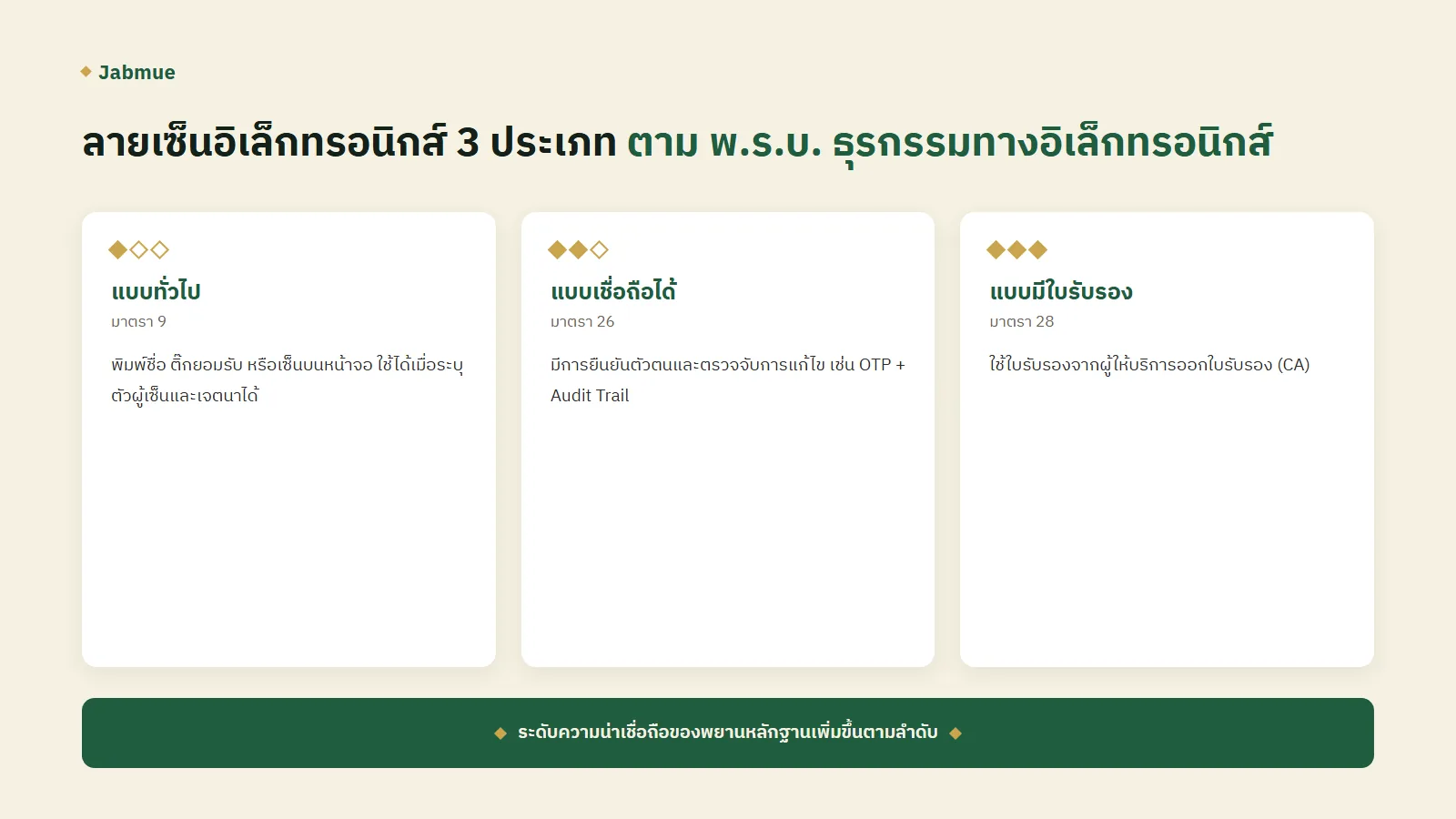
The core principle behind the law is technology neutrality: the law doesn't favor one technique over another — it simply gives electronic data the same legal effect as a paper document, as long as it can reliably identify the signer and demonstrate their intent. (ETDA, Electronic Transactions Development Agency, 2001/2008)
Why This Matters Right Now
Thailand is moving fast toward a digital economy, and clinging to paper is quietly becoming a hidden cost for businesses.
The clearest example is PromptPay, which in 2025 processed 27.4 billion transactions worth a combined US$1.6 trillion — up 12.8% year-over-year (Mastercard Global Insights, Real-time payments ignite Thailand, 2025), with more than 82.21 million registered accounts as of the end of December 2025 (Money & Banking Magazine, 2025).
This isn't an isolated trend. Thailand's broader digital economy is forecast to grow 4.2% in 2026 — roughly twice the country's GDP growth rate — reaching an estimated ฿5.6 trillion (Nation Thailand, 2026), while Thailand's digital economy value hit US$56 billion in 2025 (The Story Thailand / Google, 2025). Globally, the e-signature software market itself is growing fast — from US$3.20 billion in 2025 to a projected US$36.72 billion by 2035 (a 27.65% CAGR) (Global Growth Insights, 2025-2035), with Asia-Pacific the fastest-growing region between 2025 and 2030 (Mordor Intelligence, 2025-2030).
For businesses that haven't adapted yet, the cost of sticking with paper isn't just printing or courier fees — it's deal velocity: a real estate agent waiting on a client to hand-sign a lease can easily lose the deal to a competitor who sends a link the client can sign from their phone in minutes. A beauty clinic still relying on paper forms risks losing documents and struggles to retrieve records later. Understanding the legal framework around electronic signatures isn't just a technical detail — it's a competitive edge.
Jabmue online document signing platform
Which Law Recognizes Electronic Signatures in Thailand
The law that makes electronic signatures legal in Thailand is the Electronic Transactions Act B.E. 2544 (2001), amended in B.E. 2551 (2008). This is the foundational law establishing that all forms of electronic transactions — contracts, data transmission, or signatures — carry the same legal effect as their paper equivalents.
There are 3 key provisions every business should know:
- Section 9 gives a broad definition of an electronic signature and sets out the basic conditions for something to legally count as a "signature": it must be able to identify the signer, and show that the person accepted the content of the electronic data.
- Section 26 sets out the conditions for a "reliable electronic signature," which is presumed more trustworthy than a standard signature if the process used to create it is uniquely linked to the signer, controlled solely by the signer, and able to detect any subsequent alteration of the data.
- Section 28 sets the framework for signatures certified by a Certification Authority (CA), typically used for transactions requiring the highest level of security.
The principle underpinning all of this is non-discrimination against electronic form: the law will not deny legal effect to data or a signature simply because it exists in electronic form, as long as it meets the conditions the law sets out. (ETDA, full text of the Electronic Transactions Act B.E. 2544 (2001))
A common point of confusion is assuming that "the law recognizes it" means every document is guaranteed to win in court. In reality, whether the law recognizes something as legally valid is one question — how much evidentiary weight it carries in a dispute is another. We'll cover that in detail in the next section.
👉 Read more: Are electronically signed documents admissible in Thai courts?
The 3 Types of Electronic Signatures: Which One Fits Your Business
Which type of electronic signature you should use depends on the risk and value of the transaction — not personal preference. A low-value transaction, like an internal quote approval, may be perfectly fine with a standard electronic signature. But a high-value contract, or one with meaningful dispute risk, should use a reliable signature backed by stronger identity verification.
| Type | Reliability Level | Typical Use Cases |
|---|---|---|
| Standard electronic signature (Section 9) | Basic — identifies the signer | Quotes, internal approvals, confirmation emails |
| Reliable electronic signature (Section 26) | High — verified via OTP or equivalent | Lease agreements, sale contracts, medical consent forms |
| CA-certified signature (Section 28) | Highest — certified by a third party | Certain government documents, very high-value transactions requiring the strongest possible evidence |
In practice, most Thai SMEs default to the "reliable electronic signature" tier, since it strikes the right balance between ease of use and evidentiary strength — especially when the signer's identity is verified via OTP sent by email or phone, combined with an audit trail logging the timestamp, IP address, and device used to sign.
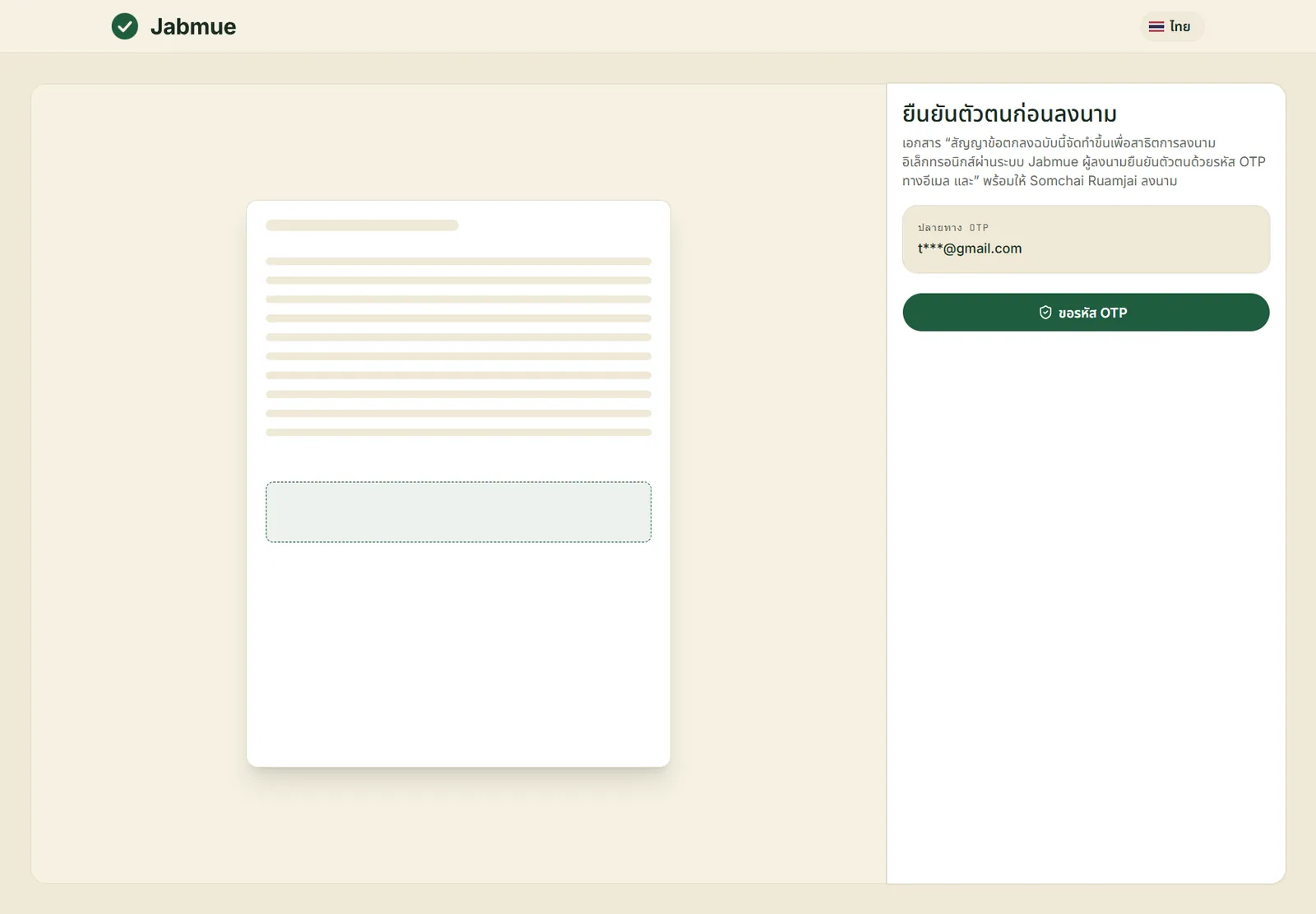
A common mistake is using a standard electronic signature with no identity verification at all for a high-value contract — for example, sending a PDF for someone to sign and return over chat, with no verification of who actually signed it. If a dispute arises later, proving who really signed becomes far harder than it needs to be.
(Our comparison of Thai e-signature tools is coming soon.)
Electronic Signature vs Digital Signature vs D-Sign
These three terms are often used interchangeably, but they mean completely different things — and D-Sign is reserved for government agencies only. This confusion is extremely common among Thai business owners.
- Electronic signature is the broad term covering every format under Section 9 of the ETA — it's the term Thai law primarily uses.
- Digital signature is one specific technique within the broader category of electronic signature, using public key encryption (PKI) to verify authenticity and prevent tampering.
- D-Sign is the digital signature system developed by the Digital Government Development Agency (DGA), designed exclusively for use within government agencies and official government correspondence — it's not a service private businesses or SMEs can sign up for directly to handle everyday business transactions.
A common misconception: "My business can use D-Sign instead of a private document-signing platform." That's incorrect. D-Sign was built specifically for government contexts and inter-agency correspondence. Private businesses that need to sign lease agreements, sale contracts, or consent forms with their customers need a private-sector electronic signature platform that complies with the Electronic Transactions Act instead.
This matters because many business owners mistakenly believe that without a government-certified system, their documents are somehow "unofficial." In reality, the law is fully open to private-sector use of electronic signatures in various forms, without needing to rely on any government system.
Electronic Signature ≠ PDPA: Two Different Laws
The Electronic Transactions Act B.E. 2544 (2001) and the Personal Data Protection Act B.E. 2562 (2019) ("PDPA") are two entirely different laws with entirely different purposes — and they are not interchangeable. This is where a lot of Thai businesses get confused, since both are often mentioned in the same breath in the context of "digital security," but they actually govern completely different things.
| Topic | ETA 2001 (amended 2008) | PDPA 2019 |
|---|---|---|
| What it governs | The validity and legal effect of electronic transactions and signatures | The collection, use, and disclosure of personal data |
| Core question it answers | "Is this electronically signed document legally valid?" | "Is my customer's personal data being collected and used properly?" |
| Enacted | B.E. 2544 (2001) (amended B.E. 2551 / 2008) | B.E. 2562 (2019) |
| Who should pay special attention | Any business signing contracts or transactions electronically | Any business collecting customer data (name, phone, email, address, etc.) |
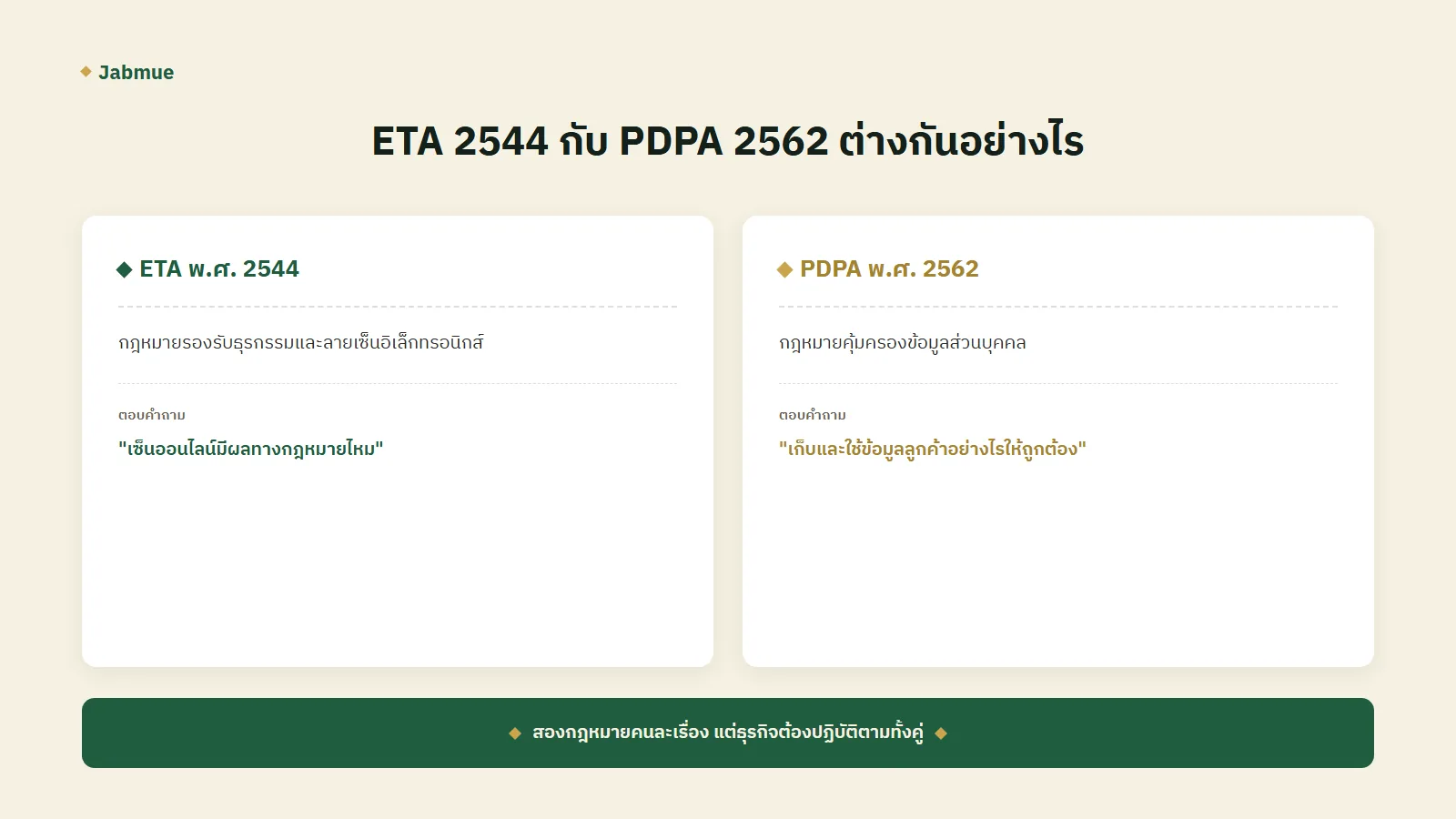
Here's the clearest way to picture it: when your business uses an online document-signing platform, whether that document is legally binding is a matter for the ETA 2001. Whether the platform stores your customer's name, phone number, and address securely, doesn't misuse that data, and has proper safeguards against data breaches is a matter for the PDPA 2019. Any business using electronic signatures needs to comply with both laws together — not just one or the other.
Understanding this distinction matters a great deal for businesses handling sensitive data — for example, a beauty clinic collecting patient health information through an electronic consent form. That document needs to be (1) legally binding under the ETA 2001, and (2) collected and processed in compliance with the PDPA 2019, at the same time.
Beauty and dental clinics using electronic consent forms
Can It Actually Be Used as Evidence in Court?
A document signed with an electronic signature can be used as evidence in court, but how much weight it carries depends on how reliable the method used to create the signature was — it's not an automatic guarantee of winning your case. This is the single most important distinction for businesses to understand, because "legal" and "strong enough evidence to win a dispute" are not the same thing.
Under Section 26 of the ETA, an electronic signature backed by a rigorous identity-verification process — such as OTP sent by email or phone — combined with an audit trail logging the timestamp, device, and IP address, is presumed to be more reliable than a standard signature with no verification at all, according to Lexology's report Overview of e-signatures in Thailand (2025).
Sending Documents via Chat or LINE
One common scenario in Thailand is agreeing to something over chat or LINE with no formal verification process in place. A message or photo sent through a chat app may not be clear enough, on its own, to fully prove who signed something or what their actual intent was. That's a different claim from saying "it can never be used as evidence in court" — in practice, Thai courts still weigh evidence in light of the surrounding context, but this kind of evidence tends to be weaker on its own and is best supported with additional evidence, such as the full chat history, proof of payment, or witness testimony, to strengthen it.
Some general legal articles published by Thai law firms reference Supreme Court decisions that touch on the admissibility of certain forms of electronic evidence — for example, cases involving ATM withdrawal records used as evidence of intent, or social media messages used in disputes over debt. However, since the references cited in this article come from secondary sources (general legal commentary), not a direct check against an official case-law database, this information should be verified with your legal counsel before relying on it for any business decision. For that reason, this article deliberately avoids citing the specifics of any particular ruling, to avoid presenting information that may be incomplete or inaccurate.
OTP and Audit Trails: Strengthening the Evidence, Not Guaranteeing It
Using OTP verification and an audit-trail logging system meaningfully strengthens the evidentiary weight of a document, but it is not a guarantee of winning in court. Every case has its own context and circumstances, and courts weigh the totality of the evidence — not just the format of the signature. What businesses can do is choose tools with strong security standards to improve the odds that their evidence will hold up — not to guarantee the outcome.
Businesses that want maximum confidence should choose a platform that combines OTP identity verification, a detailed activity log (who opened the document and when, which device and IP address they signed from), and secure, retrievable storage of the original signed document.
👉 Read more: Are electronically signed documents admissible in Thai courts?
Exceptions: Which Documents Can't Be Signed Electronically
The law doesn't cover every type of transaction for electronic signing — family and inheritance matters in particular are excluded, under Section 3 of the Royal Decree on Criteria and Procedures for Public Sector Electronic Transactions B.E. 2549 (2006). According to a summary report on the legal validity of electronic signatures in Thailand by Docusign and Siam Legal (2006).
This exception matters a great deal for businesses providing family-law or inheritance-related services, since certain documents still need to be executed on paper with a traditional handwritten signature — for example, certain documents related to divorce, adoption, or wills and estate administration.
Being upfront about these limits matters. Presenting an electronic signing platform as usable for "absolutely everything," with no exceptions, would lead businesses to use the wrong tool for documents that should stay on paper — and could create legal problems down the line. For most businesses signing leases, sale contracts, consent forms, or general business documents, these exceptions rarely come into play. But if your business deals directly with family or inheritance matters, you should consult your legal counsel before using an electronic signature for that type of document.
Which Thai Businesses Are Already Using It
Real estate agents, beauty and dental clinics, and many Thai SMEs are already using electronic signatures today to speed up their sales cycles and stay compliant. This trend tracks Thailand's broader digital transformation market, where cloud solutions held 55% market share in 2025, and SMEs are growing at 14.95% per year through 2031 (Mordor Intelligence, Thailand Digital Transformation Market, 2025-2031).
Real Estate Agents
Real estate agents use electronic signatures to close lease and sale agreements noticeably faster. Instead of scheduling an in-person meeting to sign or waiting for paper documents to go back and forth, an agent can send a signing link straight to a client's phone and get it signed within minutes — with OTP verification adding to the contract's evidentiary strength. In a market where tenants and buyers decide quickly and can change their minds at any moment, deal speed is the deciding factor.
Real estate agents using electronic lease and sale agreements
Beauty and Dental Clinics
Clinics use electronic signatures for pre-procedure consent forms, cutting down front-desk wait times for patients and making record-keeping far more organized than a paper filing cabinet. That said, clinics need to stay on top of both the ETA 2001 (signature validity) and the PDPA 2019 (protecting patient health data) at the same time.
Beauty and dental clinics using electronic consent forms
SMEs and General Service Businesses
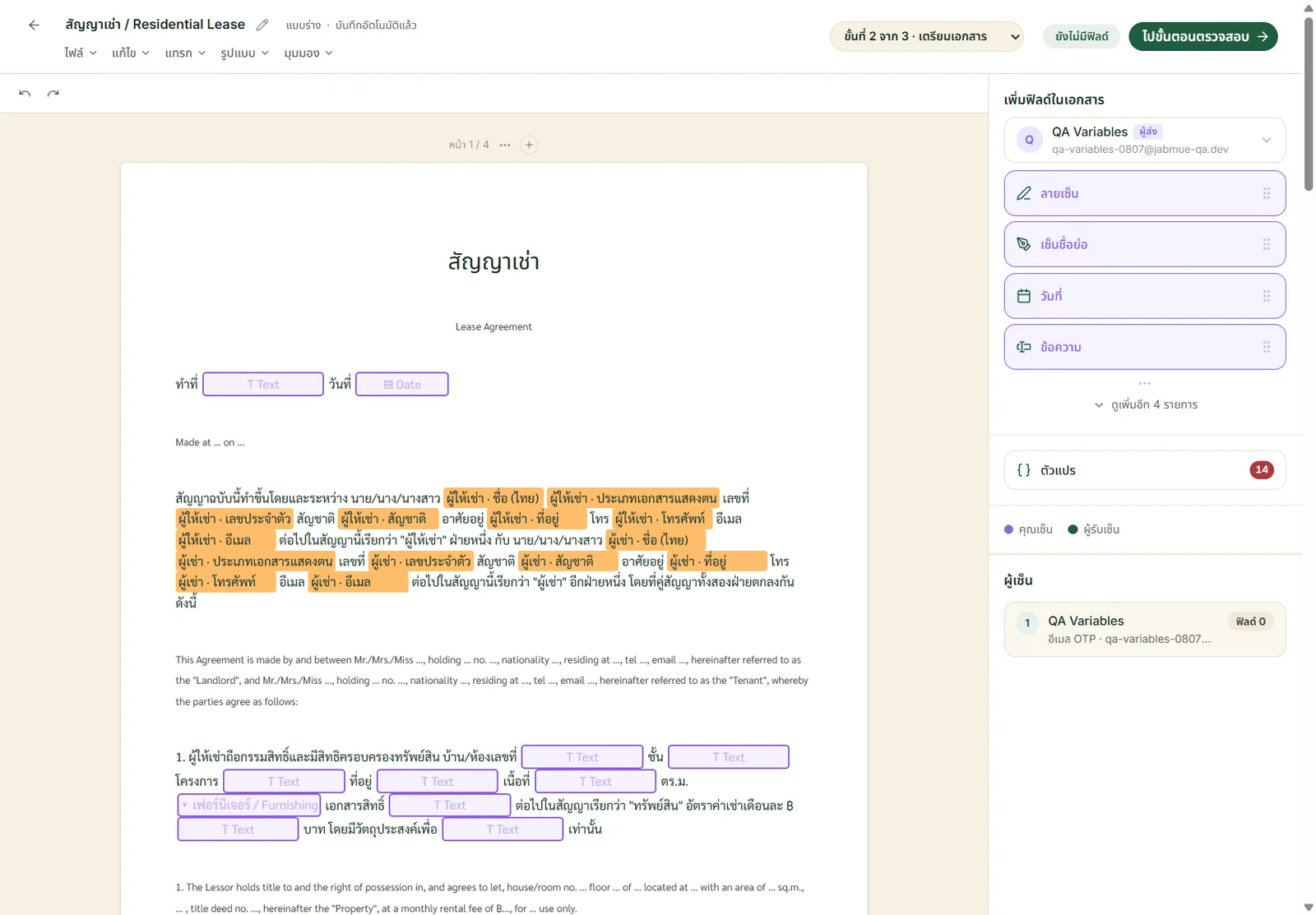
Beyond these two core groups, a growing number of Thai SMEs are adopting electronic signatures for quotes, employment contracts, and internal approval documents, cutting down on repetitive paperwork and speeding up business operations overall.
What's Changing in 2026: The New Draft Electronic Transactions Act
The Electronic Transactions Development Agency (ETDA) opened a public consultation on a major overhaul of the electronic transactions law between May 12 and June 15, 2026. Key proposed changes include expanding the definition of an electronic signature to cover biometric data, and shifting the burden of proof to favor more "reliable" verification methods. (Tilleke & Gibbins, Thailand Set to Overhaul Its E-Transactions Framework, 2026)
This overhaul could meaningfully reshape Thailand's digital business landscape over the next few years.
The draft law covers several important areas:
- Formal recognition of electronic timestamps (e-timestamps), which would help establish the exact time a transaction or signature took place.
- Digital corporate seals, which would let legal entities use an electronic seal with the same legal effect as a physical company stamp.
- Recognition of fully automated contracts, opening the door for transactions carried out entirely through AI or automated systems to carry clear legal effect.
- A shift in the burden of proof to favor identity-verification methods that carry higher reliability — which could give signatures backed by rigorous verification (like OTP plus an audit trail) noticeably clearer evidentiary weight going forward.
Based on Thailand's typical legislative timeline, a draft law like this usually takes around a year before passing through parliament and taking full legal effect. Businesses still have time to prepare, but should start following its progress closely — especially those that rely heavily on digital transactions.
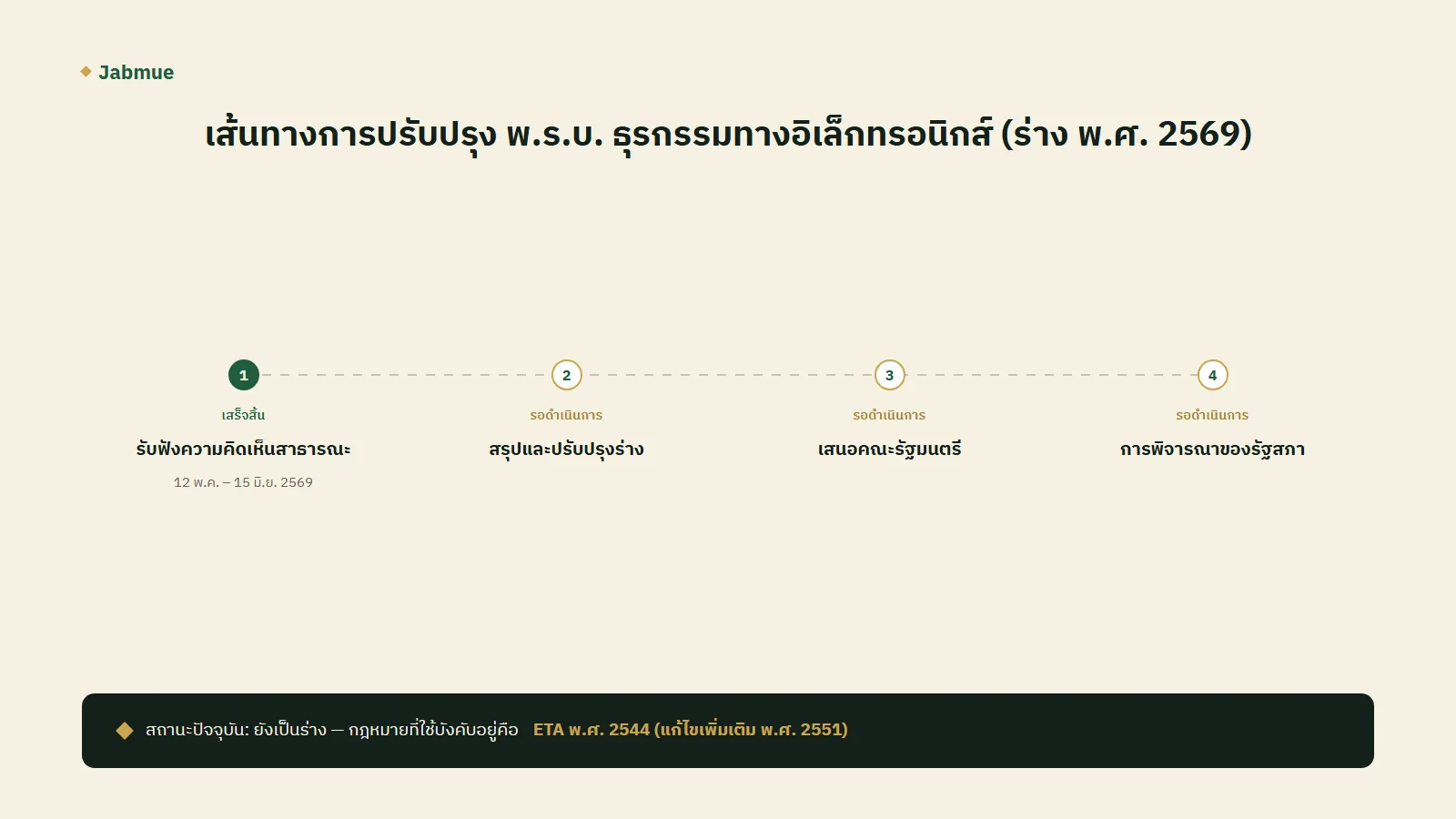
Interestingly, this reform is happening alongside the rapid expansion of Thailand's digital ID infrastructure, which now has more than 162.63 million registered Digital ID accounts (Biometric Update, Thailand positions digital ID as backbone, 2026) — a clear signal that the Thai government is investing heavily in the infrastructure needed to support broader digital identity verification in the years ahead.
Strengthening the Evidentiary Weight of Your E-Signature
If your business already uses electronic signatures and wants to strengthen the evidentiary weight even further, here are some practices worth considering.
Multi-factor verification is the most effective approach — combining OTP by email or SMS with verification through a channel the signer already trusts, like a LINE Official Account, which helps reduce the risk of someone else signing on their behalf.
A timestamped audit trail should cover, at minimum: when the document was opened, when the OTP was confirmed, when the signature was actually applied, the IP address, and the type of device used. None of this guarantees the outcome of a case, but it builds a complete picture of the signing process — which can be extremely valuable if you ever need to produce supporting evidence later.
Businesses that want maximum confidence should look for a platform that bundles all three elements into a single system — identity verification, audit trail, and secure storage of the original document — rather than stitching several separate tools together, which often creates blind spots in the process without anyone realizing it.
One thing worth keeping in mind: these safeguards are about reducing risk, not eliminating it entirely. Businesses with high-value transactions or particularly sensitive legal exposure should consult their legal counsel alongside choosing the right technical tools.
If you're looking for a platform with OTP identity verification, a detailed audit trail, and ready-made Thai contract templates, you can start a free 14-day trial — no credit card required.
Tools and Options on the Market
Thailand's electronic document-signing market has several providers, each with its own strengths. Choosing the right tool comes down to how well it understands Thai legal context, how easy it is to use, and how complete its feature set is. Whichever provider you choose, the first thing to check is whether online document signing is legally valid — and most providers in the Thai market do, in fact, comply with the ETA.
Broadly speaking, e-signature tools in the Thai market fall into two groups:
- Global platforms adapted for the Thai market, such as esigns.cloud, veracity.biz, zdox.net, and i-box.app — these offer a wide range of capabilities, but some lack Thai contract templates built specifically for local legal context.
- Platforms built specifically for the Thai market, which typically come with contract templates aligned with Thai law, full Thai-language support, and a deeper understanding of how Thai businesses actually work across different industries.
(Our comparison of Thai e-signature tools is coming soon.)
One factor worth paying special attention to is ready-to-use contract templates built for Thai legal context, since drafting a contract from scratch every time is an unnecessary burden for most SMEs. Jabmue is one platform that offers 24 bilingual Thai legal document templates, covering everything from lease agreements and sale contracts to medical consent forms — helping businesses get started immediately instead of starting from zero.
Whichever tool you choose, the key things to check before deciding are: the identity-verification methods it supports (email/SMS OTP), its audit-trail logging capability, full Thai-language support, and a solid understanding of Thailand's specific legal requirements.
How to Get Started
The first thing you can do right away is try an electronic document-signing platform for free, to see if it fits your business's workflow before committing long-term.
Step 1: Start a free 14-day trial. Sign up for a platform that understands Thai legal context, with no credit card required, and start uploading your first document within minutes.
Step 2: Choose a template that fits your business. Instead of drafting a contract from scratch, pick from the ready-made bilingual Thai legal document templates — lease agreements, sale contracts, medical consent forms — and customize the details to fit your transaction.
Step 3: Send your first document with OTP and track the audit trail. Send a signing link to the other party. The system verifies their identity via OTP and automatically logs the full activity history. You can track in real time whether the document has been opened, signed, or is still pending.
If you're still wondering, "will this document actually be legally binding?" — the answer is: as long as your transaction doesn't fall into an excluded category (family or inheritance matters) and uses an appropriate identity-verification process, a document signed through an electronic platform is fully binding under the ETA (see Can It Actually Be Used as Evidence in Court? above for details).
Frequently Asked Questions
What is an electronic signature?
An electronic signature is any letter, character, number, sound, or other electronic symbol attached to electronic data to identify the signer, as defined under Section 9 of the Electronic Transactions Act B.E. 2544 (2001). It covers everything from typing your name, to checking a box to accept terms, to drawing your signature with your finger on a mobile screen.
Is an electronic signature legal in Thailand?
Yes. Electronic signatures are legal in Thailand under the Electronic Transactions Act B.E. 2544 (2001) (amended B.E. 2551 / 2008), which gives them the same legal effect as a signature on paper — with the exception of certain transactions related to family and inheritance matters, which are excluded under a 2006 Royal Decree.
Can an electronic signature be used in court?
A document signed with an electronic signature can be used as evidence in court, but how much weight it carries depends on how reliable the method used to create the signature was. A signature verified via OTP with a detailed audit trail is presumed more reliable than a standard signature with no verification — but that's not an automatic guarantee of winning your case. See Can It Actually Be Used as Evidence in Court? for more detail.
How is an electronic signature different from the PDPA?
An electronic signature falls under the Electronic Transactions Act B.E. 2544 (2001), which governs the validity and legal effect of transactions. The PDPA (Personal Data Protection Act B.E. 2562 / 2019) governs the collection, use, and disclosure of personal data. They're two entirely different laws serving different purposes, and any business using electronic signatures needs to comply with both together.
Can a private company use the government's D-Sign system?
Not directly. D-Sign is a digital signature system developed by the Digital Government Development Agency (DGA), designed exclusively for use within government agencies and official government correspondence. Private companies looking to sign business contracts or documents should use a private-sector electronic signature platform that complies with the Electronic Transactions Act instead.
Which documents can't be signed electronically?
Transactions related to family and inheritance matters are excluded from electronic signing, under Section 3 of the Royal Decree on Criteria and Procedures for Public Sector Electronic Transactions B.E. 2549 (2006). For most businesses signing lease agreements, sale contracts, or consent forms, this exception rarely applies — but businesses directly involved in family or inheritance matters should consult their legal counsel before deciding.
How do I get started with electronic signatures on Jabmue?
Start with a free 14-day trial, no credit card required. Then choose from 24 ready-made bilingual Thai legal document templates, customize the details to fit your transaction, and send a signing link with OTP to the other party. The system automatically logs the audit trail throughout the entire process.
Conclusion
Electronic signatures are unambiguously legal in Thailand under the Electronic Transactions Act B.E. 2544 (2001) — but how much evidentiary weight they carry in a dispute depends on how the signature was created. Businesses that understand the distinction between "legal" and "evidentiary weight" can confidently choose the right tools and processes for the risk profile of each type of transaction.
This guide covered the legal foundation (ETA 2001), the difference between electronic signatures, digital signatures, and D-Sign, how it differs from the PDPA 2019, its evidentiary weight in court, the exceptions you need to know, and the new draft law set to reshape the landscape in 2026. This area of law is continuing to evolve to accommodate new technologies like biometric data and automated contracts. Businesses that start adopting e-signatures today will be better positioned to adapt as the law continues to change.
Ready to get started? Start your free 14-day trial — no credit card required — and experience document signing that's both fast and legally sound.
Keep Reading
Legal Fundamentals and Evidence:
- A deeper dive into the evidentiary weight of e-signatures in court
- Frequently asked questions about online document signing
Tools and Comparisons:
- Comparing electronic document-signing tools in Thailand, 2026 (coming soon)
- Starter plans and the free 14-day trial
Industry Use Cases:
- Real estate agents using electronic lease and sale agreements
- Beauty and dental clinics using electronic consent forms
This content is provided for general educational purposes and does not constitute legal advice for any specific situation. Before making any significant business decision, consult your legal counsel to assess your business's specific circumstances. Written by the Jabmue team — an online document-signing platform for Thai businesses.
What Is Stamp Duty in Thailand? Which Contracts Need It, and What to Do When You Sign Online (2026)
What is stamp duty, which contracts in Thailand need it, and do contracts signed online through a system like Jabmue still owe stamp duty? Plus how to pay electronic stamp duty (e-Stamp) through the Thai Revenue Department.
Read article →Can You Sign Documents via LINE? A Straight Answer (2026)
Can you sign documents via LINE? Yes, but sending a photo of a signature in chat and signing through an OTP-verified link carry very different legal weight. Here's the comparison.
Read article →Is Daily Condo Rental (Airbnb-Style) Legal in Thailand? What to Know Before Signing a Short-Term Rental Contract
Renting out a condo by the day, Airbnb-style, sits in a genuine legal grey zone in Thailand. The Hotel Act B.E. 2547 (2004) and condominium juristic person rules can both apply. This article explains the risks honestly, plus the clauses a short-term rental contract should include.
Read article →Service Agreement in Thailand: Hire of Work vs Employment Contract, What Actually Changes
A Thai service agreement (hire of work) and an employment contract look similar, but the tax and legal consequences are very different. See the 6 clauses every B2B service agreement needs, plus the points Thai businesses miss most often.
Read article →Rental Security Deposit in Thailand: When It Must Be Returned, What Can Be Deducted, and the Refund Letter
When must a rental security deposit be returned in Thailand? What deductions are lawful, what tenants can do if it isn't returned, and the deposit refund letter every landlord should use — with a ready-made template.
Read article →Thai Receipt Template: How It Differs from e-Tax Invoice, and What Jabmue Can (and Can't) Do
An ordinary receipt and the Revenue Department's e-Tax Invoice are not the same document. This article explains the difference, and says it plainly: Jabmue can create and sign electronic receipts, but it is not an e-Tax Invoice system that files directly with the Revenue Department.
Read article →Quotation Template Thailand: What to Include, Is It Binding, and Can Clients Accept Online?
Quotation template for Thailand: the elements every quote needs, itemized pricing, 7% VAT, validity period, how a quote differs from a purchase order, and how to get clients to sign their acceptance online.
Read article →Property Purchase Agreement + Deposit in Thailand: What to Check Before You Sign
Thailand's agreement to purchase and sell explained: the deposit terms, the clauses it must contain, what happens on breach, and how it differs from the ownership transfer at the Land Department.
Read article →Loan Agreement in Thailand: Over ฿2,000 Needs Written Evidence, Interest Capped at 15%/Year
What must a Thai loan agreement include? Loans over ฿2,000 need signed written evidence (Section 653), interest is capped at 15% per year (Section 654), plus stamp duty and how to sign online.
Read article →Thailand's Draft ETA Amendment (2026): What Could Change
ETDA is seeking public comment on a draft ETA amendment. This is still a draft, not law in force yet: here's what it proposes and the latest status.
Read article →PDPA for Real Estate Agents: How to Collect Tenant and Buyer Data Legally
How real estate agents can collect tenant and buyer data in line with the PDPA — a practical checklist, plus what to watch out for when asking for ID card copies
Read article →Is a Pasted Signature Image in a PDF Valid? How It Differs from a Real E-Signature (2026)
Is a pasted signature image in a PDF valid? It works in practice, but it is not an electronic signature in the legal sense. Here's the difference, and the risks you should know before using one.
Read article →Is an MOU Legally Binding in Thailand? The Honest Answer Is "It Depends", and Here's How to Check
Many people assume an MOU is never legally binding. In some cases, though, a Thai court may read an MOU as an enforceable contract. Learn the 4 things that make an MOU binding by accident, and how to draft one that matches what you actually intend.
Read article →NDA in Thailand: Template, Key Clauses and E-Signing
A sample NDA for Thai businesses: essential clauses, fair duration, penalties courts won't reduce, and how it differs from PDPA. Ready-to-sign template.
Read article →Jabmue vs zDOX: 2026 Comparison (Generic Templates or Ready-to-Use Thai Legal Contracts)
Jabmue vs zDOX compared: per-user pricing, Thai legal contract templates, LINE bot, NDID, and PromptPay (prices verified Aug 2026)
Read article →Jabmue vs eSigns.cloud: 2026 Comparison (Tax-Audit Readiness or an All-in-One Contract Tool)
Jabmue vs eSigns.cloud compared: pricing, document editor, Thai legal templates, e-Tax XML, and PromptPay (prices verified Aug 2026).
Read article →Jabmue vs DocuSign (2026): Which E-Signature Tool Fits Your Thailand Operations?
Jabmue vs DocuSign compared for companies operating in Thailand: pricing, Thai-language support, PromptPay, LINE, and legal templates. Verified August 2026.
Read article →Best E-Signature Tools in Thailand (2026): Pricing, Features, and the Right Pick for Your Business
Compare Jabmue, eSigns.cloud, zDOX, Veracity, and 5 more: real pricing, Thai legal templates, PromptPay, and LINE support — pricing verified Aug 2026
Read article →Real Estate Broker Agreement in Thailand: Protect Your Commission
Real estate broker agreement Thailand sample with explanation: Thai law doesn't require it in writing, but in practice, without written proof, claiming your commission is extremely difficult. References Sections 845-846 of the Civil and Commercial Code, plus a ready-to-use exclusive listing agreement template.
Read article →PDPA Checklist for Clinics in Thailand: 9 Obligations, 9 Documents
PDPA checklist for clinics in Thailand: how patient data consent works, whether you need a DPO, and what documents you actually need — with templates ready to sign.
Read article →Are Electronically Signed Documents Admissible in Thai Courts? FAQ (Updated 2026)
Are electronically signed documents admissible in Thai courts? The short answer is yes, with conditions, under the Electronic Transactions Act B.E. 2544 (2001) — with real Supreme Court decisions and ways to strengthen reliability using OTP and an audit trail.
Read article →Lease Termination Notice in Thailand: Templates and Legal Steps
What must a lease termination notice and overdue rent demand letter include? Read the steps under Sections 560/566 of the Civil and Commercial Code, with the correct structure and provable delivery methods (Updated 2026).
Read article →The HR Documents You'll Issue Most Often in Thailand: Warning Letters, Resignation Letters, Employment Certificates
Warning letters, resignation letters, and employment certificates are the 3 HR documents Thai SMEs issue most often, and getting them wrong creates real legal problems. Learn how long a warning letter stays valid, the real resignation notice rules, and what employers are legally required to issue.
Read article →How to Send a Document for Online Signature in 10 Minutes (With Real Screenshots)
Send a document for online signature in 10 minutes — no printing, no scanning, no account needed for the signer, with real screenshots of every step
Read article →Debt Acknowledgment in Thailand: What It Is, How It Differs From a Loan Agreement, and How the Limitation Period Resets
What is a debt acknowledgment letter in Thailand? How it differs from a loan agreement, how it interrupts and resets the limitation period, whether witnesses are required, what it must say, and how to sign it online.
Read article →Can AI Draft a Contract? What the Risks Are (A Straight Answer for 2026)
Can AI like ChatGPT or Gemini draft a contract? Yes, but there are risks you need to know: legal references that may be outdated, potentially unfair contract terms, and the fact that AI-written text is not a legally binding document.
Read article →Power of Attorney in Thailand: Which Form for Which Use?
Power of Attorney Thailand: which form for which use? This guide maps every POA type, Land Office to general business, and what is e-signable.
Read article →PDPA Consent Form Generator: Beyond the Cookie Banner
Most PDPA consent form generators only cover cookies. Build a printable, bilingual consent form for Thai clinics and SMEs, free templates included.
Read article →Notary Public in Thailand vs. E-Signature: What Foreigners Need
Thailand has no Western-style notary public, only Notarial Services Attorneys. Here's when you actually need one and when a legally valid e-signature is enough.
Read article →Freelance Contract in Thailand: From LINE Chats to a Signed Agreement
Freelancers in Thailand have no labor-law protection. See the 8 clauses your contract needs, and how to turn LINE chats into a signed agreement.
Read article →Employment Contract in Thailand: Template and E-Signing Guide
A ready-to-use bilingual Thai-English employment contract template, with a legally compliant e-signing process via OTP and audit trail, plus a staff NDA.
Read article →Electronic Signature vs Digital Signature in Thailand (2026)
Electronic signature (Section 9) vs digital signature (Sections 26-28) under Thai law: which one your business actually needs, with a comparison table.
Read article →How Secure Are Electronic Signatures? An Honest Answer
How secure are electronic signatures? An honest look at what OTP and an audit trail protect, what they don't, and how to spot fake signing links.
Read article →Condo Lease Agreement in Thailand (Thai-English): Complete Guide
A ready-to-use Thai-English condo lease agreement you can fill in and sign online with OTP, valid under Thai law (Electronic Transactions Act B.E. 2544 (2001)). No printing or scanning required — plus a clear explanation of when leases over 3 years must be registered.
Read article →Digital Informed Consent for Aesthetic and Dental Clinics in Thailand
What must a valid informed consent form include? A guide for aesthetic and dental clinics in Thailand: legally required content, how to separate it from PDPA consent, and how to digitize it without legal risk.
Read article →Certified True Copies in Thailand: Can You Sign Them Online?
Can you sign a certified true copy online in Thailand? A straight answer on when e-signatures work, when you still need wet ink, and how to certify safely.
Read article →Documents for Accounting Firms: Tax Filing Power of Attorney, Engagement Letters, and the Paperwork That Comes Back Every Month
The tax filing power of attorney, engagement letter, and other documents Thai accounting firms handle every month — plus how to get clients to sign online without printing anything
Read article →Ready to stop chasing paper signatures?
Start your free 14-day trial — no credit card required.